
API and API Threats: The Silent Security Crisis in the Digital World
APIs: Powering the Digital World — and Its Greatest Security Risk
Imagine logging into your favourite app with one click or checking your bank balance through a budgeting tool.
These seamless experiences are powered by APIs — Application Programming Interfaces — the invisible digital bridges that connect software systems.
In 2025, APIs handle over 80% of global internet traffic, driving innovation across mobile, IoT, AI, and cloud ecosystems.
The global API management market is valued at $10.02 billion in 2025 and is expected to surge to $108.61 billion by 2033 (CAGR 34.7%).
Meanwhile, the API security market itself is booming — expected to reach $1.25 billion in 2025 (CAGR 29.66%).
Explosive growth of API’s comes with rising risk. APIs, designed for openness and interoperability, have become prime targets for attackers.
Gartner predicted that by 2025, API attacks would surpass traditional web exploits — a forecast that has become reality.
Recent studies show 99% of organizations experienced API security incidents in the past year, and 57% suffered actual breaches.
High-profile examples — from T-Mobile’s API breach (2023) exposing 37 million customer records to the xAI API key leak (2025) — underline what’s at stake: data theft, service disruption, regulatory fines, and loss of customer trust.
API Growth vs. API Threats Rising Together
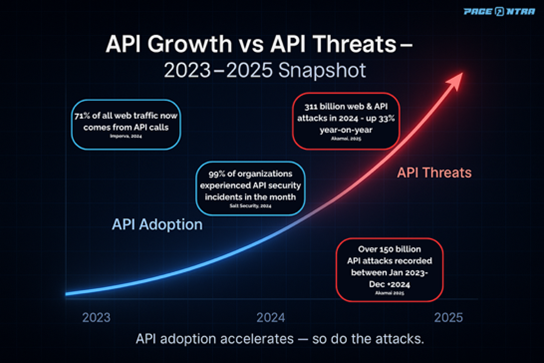
API adoption accelerates — so do the attacks.
What Are APIs and Why They Matter in 2025
APIs are the digital connectors that allow software applications to communicate securely and efficiently.
Think of them as bridges or adapters — your fitness app fetching health data, your e-commerce site calling a payment gateway, or your CRM syncing with marketing tools.
Common Types of APIs
- Public APIs — Open to external developers (e.g., Google Maps API).
- Private APIs — Internal to an organization’s backend systems.
- Partner APIs — Shared between trusted collaborators such as payment processors.
Architectural Styles
- REST APIs: Lightweight, widely used in web/mobile apps.
- GraphQL APIs: Flexible queries, but can overexpose data if misconfigured.
- SOAP APIs: Structured and reliable — common in enterprise environments.
How APIs Work
Every API interaction follows a request–response model:
- HTTP methods: GET, POST, PUT, DELETE.
- Data formats: JSON / XML.
- Authentication: API Keys, OAuth 2.0, JWT.
- Status codes: 200 (success), 404 (not found), 500 (server error).
In a world of microservices, serverless computing, and AI integrations, APIs are the arteries of digital transformation — and the attack surface of tomorrow.
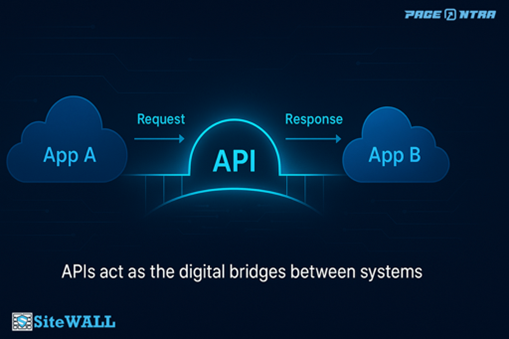
APIs act as the digital bridges between applications.
Top API Threats in 2025: OWASP API Security Top 10 Explained
The OWASP API Security Top 10 (updated 2023) remains the foundation for identifying critical API vulnerabilities.
Incidents linked to these issues have surged 32% YoY, with 94% of businesses reporting problems in production APIs.
OWASP API Top 10 Threats – 2023
The Essential Guide to Modern API Security Risks
APIs are the backbone of modern digital ecosystems—but with their rise, API-specific vulnerabilities have become prime targets for attackers. Below are the OWASP API Top 10 vulnerabilities for 2023, each representing a critical class of security risks developers and security teams must defend against.
API1:2023 – Broken Object Level Authorization (BOLA) – | APIs fail to enforce proper access controls, allowing attackers to manipulate object IDs to gain unauthorized access to data belonging to other users. |
API2:2023 – Broken Authentication | – Weak or missing authentication mechanisms (such as poorly validated tokens or expired sessions) enable attackers to impersonate users or bypass login restrictions. |
API3:2023 – Broken Object Property Level Authorization | APIs unintentionally expose sensitive object properties or fields in responses due to inadequate validation or filtering at the property level. |
API4:2023 – Unrestricted Resource Consumption | Lack of request throttling or resource limitation allows attackers to exhaust API resources, leading to Denial of Service (DoS) attacks. |
API5:2023 – Broken Function Level Authorization | Attackers gain unauthorized access to privileged or administrative functions due to missing or improper function-level authorization checks. |
API6:2023 – Unrestricted Access to Sensitive Business Flows | Automated scripts or bots exploit key workflows (e.g., checkout, payment, registration) because APIs fail to restrict how and when those flows are accessed. |
API7:2023 – Server-Side Request Forgery (SSRF) | Vulnerable APIs can be manipulated to fetch or interact with internal or malicious URLs, exposing internal networks and sensitive systems. |
API8:2023 – Security Misconfiguration | Default configurations, exposed debugging information, unnecessary HTTP methods, or open cloud storage buckets expose APIs to exploitation |
API9:2023 – Improper Inventory Management | Organizations lack complete visibility into all APIs—especially deprecated, shadow, or test endpoints—leading to unmanaged attack surfaces. |
API10:2023 – Unsafe Consumption of APIs | Applications integrate external or third-party APIs without verifying input/output integrity, creating risks of data tampering or supply chain compromise. |
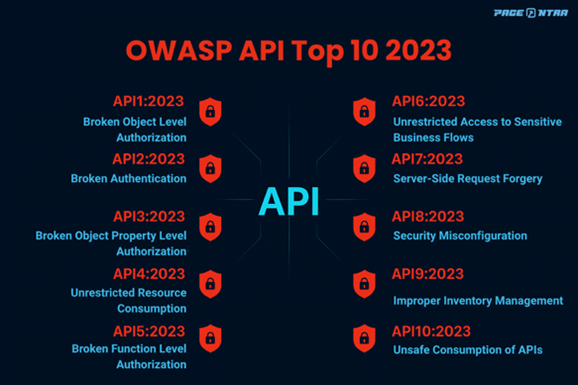
The OWASP Top 10 — still the foundation of API risk management.
The OWASP API Top 10 (2023) serves as the foundation for API risk management—helping organizations build, test, and operate APIs with security-first principles.
Emerging in 2025
- Generative AI prompt-injection attacks.
- Automated bot campaigns targeting API endpoints.
- Cross-tenant data exposure in multi-cloud setups.
API Threat Lifecycle — From Discovery to Defense
- Discovery: Identifying the API or its endpoints.
- Enumeration: Mapping out the API’s structure or potential weaknesses.
- Exploitation: Actively using vulnerabilities to gain unauthorized access.
- Breach: Successful compromise or data exposure.
- Response: Actions taken to mitigate the breach.
- Defense: Implementing measures to prevent future incidents.
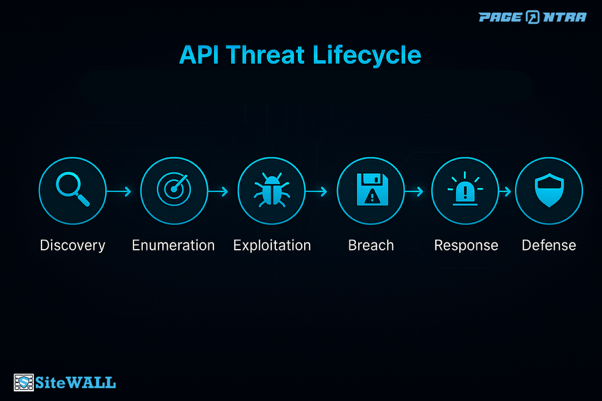
API Threat Lifecycle — From Discovery to Defense – Understanding the API threat lifecycle helps security teams stay ahead
API Security Best Practices and Defense Strategies
To defend modern APIs, security must be multi-layered, continuous, and proactive.
Key Best Practices
- Strong Authentication & Authorization: Use OAuth 2.0 or JWT; apply RBAC / least-privilege.
- Input Validation & Sanitization: Prevent injection attacks.
- Rate Limiting & Throttling: Block DoS / brute-force attempts.
- Encryption: Enforce HTTPS + data-at-rest encryption.
- Schema Validation: Accept only expected payloads.
- Comprehensive Inventory: Detect all APIs (including shadow ones).
- Continuous Monitoring: Leverage SIEM / AI-based analytics.
- Regular Penetration Testing: Fuzz, scan, and patch continuously.
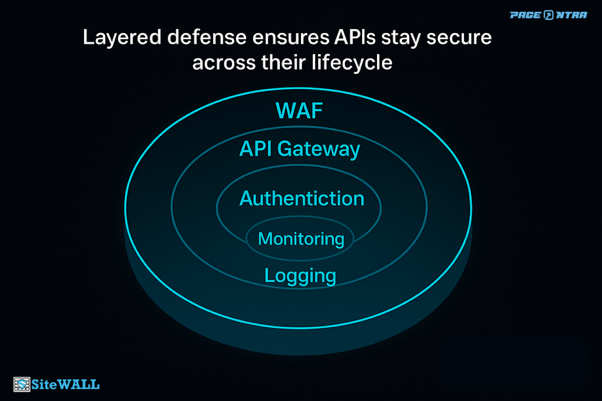
Layered API Security Stack – Layered defense ensures APIs stay secure across their lifecycle.
The API Security Audit Workflow
A disciplined audit process is vital for long-term resilience.
- Inventory APIs
- Scan for Vulnerabilities
- Test Authentication Mechanisms
- Review Logs and Metrics
- Patch and Monitor
- Reassess Periodically
Case Studies: Real-World API Breaches
These incidents reveal the recurring nature of API risks.
Organization | Year | Attack Vector | Impact Summary | Lesson Learned | Source |
T-Mobile (USA) | 2022–23 | Exposed API endpoint | 37 M records accessed | Apply authorization & rate limits | Salt Security |
xAI (Elon Musk) | 2025 | API key leak in GitHub | 52 private LLMs exposed | Use secret management tools | Krebs on Security |
Optus (Australia) | 2022 | Unauthenticated API endpoint | 9 M records breached | Enforce auth on internal APIs | Cloud Range Cyber |
Peloton | 2021 | Insecure API | Private user data exposed | Implement RBAC + tokens | TechCrunch |
Twitter (X) | 2022 | Improperly secured endpoint | 5.4 M accounts scraped | Limit endpoints & data returns | Bleeping Computer |
US Healthcare Sector | 2024 | API misconfiguration | 79% reported API incidents | Encrypt & comply with HIPAA | HIPAA Journal |
The Way Forward: Securing Innovation
APIs are the digital arteries of the modern enterprise, but they are also prime cyber targets.
According to Cyber Defense Magazine (June 2025), 57% of organizations have experienced API-related breaches in the past two years, with many incidents resulting in six-figure recovery costs from downtime, remediation, and regulatory exposure (IBM Security, Imperva).
Regulators like SEBI, RBI, CERT-In, GDPR, and CCPA now emphasize API protection within compliance frameworks.
Organizations can strengthen their resilience through:
- Full API inventory and discovery.
- OAuth 2.0 / JWT authentication.
- Advanced WAFs (e.g., SiteWALL) with deep API inspection.
- Continuous monitoring and alerting (SIEM + SOAR).
APIs power your business. SiteWALL protects it — one request at a time.
Further Reading
- OWASP API Security Project
- NIST SP 800-204: Security Guidelines for APIs
- API Security in Action by Neil Madden