
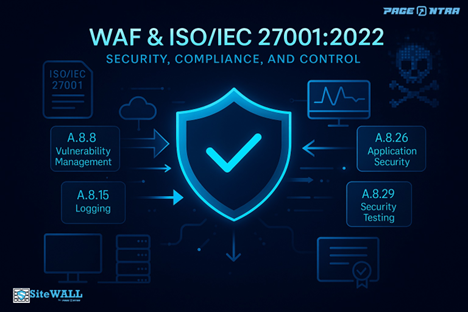
How Web Application Firewalls (WAFs) Align with ISO/IEC 27001:2022 Technological Controls
Executive Summary
Web Application Firewalls (WAFs) are critical for achieving ISO/IEC 27001:2022 compliance, protecting web applications from threats like SQL injection, cross-site scripting (XSS), and distributed denial-of-service (DDoS) attacks, while aligning with Annex A, Section A.8 (Technological Controls). WAFs, such as SiteWALL, AWS WAF, and Cloudflare, support controls like A.8.8 (Vulnerability Management), A.8.15 (Logging), and A.8.26 (Application Security) through runtime protection, logging, and risk mitigation. This article provides actionable configurations, a case study, and a compliance checklist for integrating WAFs into Information Security Management Systems (ISMS), Security Information and Event Management (SIEM)/Security Orchestration, Automation, and Response (SOAR) platforms, and DevSecOps pipelines. It addresses emerging threats (e.g., AI-driven botnets) and cross-standard compliance (e.g., PCI DSS, HIPAA, GDPR) to ensure audit readiness.
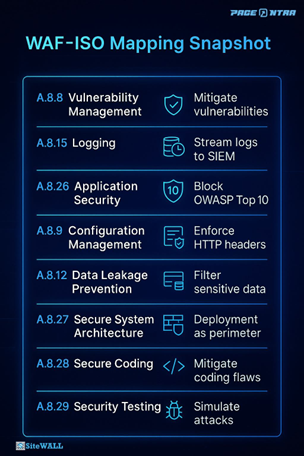
Figure 1: WAF-ISO 27001 Mapping Snapshot – Diagram illustrating how WAF features align with ISO 27001:2022 controls (e.g., A.8.8, A.8.26).
Quick WAF Compliance Checklist:
- Configure protections for OWASP Top 10 vulnerabilities (A.8.26).
- Stream logs to SIEM/SOAR for monitoring (A.8.15).
- Document configurations in the Statement of Applicability (SoA) (Clause 6.1.3).
- Update rules quarterly with threat intelligence (A.8.8).
- Conduct annual penetration tests (A.8.29).
- Train staff on WAF management and incident response (A.6.3).
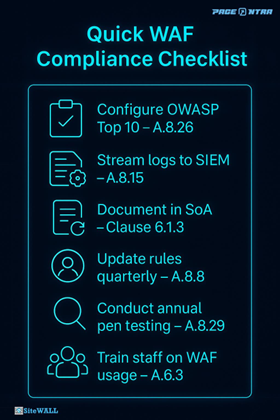
Figure 2: WAF Compliance Checklist – Visual summary of key compliance steps for WAF implementation.
Introduction
Web applications face increasing threats, including OWASP Top 10 vulnerabilities (e.g., SQL injection, XSS) and AI-driven attacks like botnets, risking data breaches and service disruptions. ISO/IEC 27001:2022 provides a framework for managing these risks through an ISMS, with 93 controls in Annex A, including Section A.8’s technological controls for securing web applications. This article outlines how WAFs support ISO 27001:2022 compliance, offering practical configurations, a case study, and guidance for cybersecurity professionals, auditors, and managers to protect applications and meet international standards.
Understanding Web Application Firewalls (WAFs)
WAF Functionality
WAFs inspect HTTP(S) traffic to block threats, including:
- OWASP Top 10 Threats (A.8.26): Mitigates A01:2021—Broken Access Control (e.g., unauthorized API calls), A03:2021—Injection (e.g., SQL injection), and A07:2021—XSS (e.g., malicious scripts).
- Emerging Threats: Counters AI-driven botnets, formjacking, and zero-day exploits (detailed in “Addressing Emerging Threats”).
Deployment Options:
- Cloud-Based: Hosted on platforms like AWS WAF or CDNs (e.g., Cloudflare).
- On-Premises: Uses solutions like ModSecurity or proprietary appliances.
- Hybrid: Combines cloud and on-premises for scalability.
Figure 3: WAF Deployment Options – Diagram comparing cloud, on-premises, and hybrid WAF architectures.
WAF Capabilities
- Managed Rules: Preconfigured rulesets block common vulnerabilities (e.g., SQL injection patterns like UNION SELECT).
- Rate-Limiting and Bot Detection: Mitigates DDoS by limiting requests (e.g., 100 requests/minute per IP).
- Custom Rules: Uses regex for sensitive data (e.g., \b\d{4}-\d{4}-\d{4}-\d{4}\b for credit card numbers).
- Advanced Features:
- Machine learning for anomaly detection.
- Threat intelligence integration for real-time rule updates.
- Script integrity checks to prevent formjacking.
Integrating WAFs into the ISMS
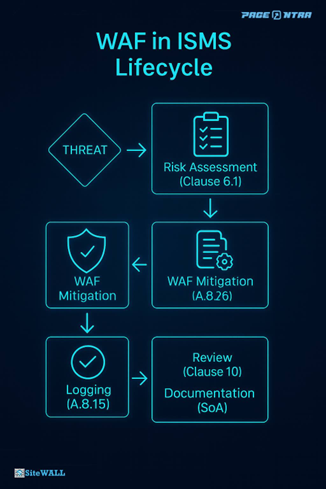
Figure 3: WAF in ISMS Lifecycle – Diagram showing WAF integration across ISMS phases (risk assessment, implementation, monitoring).
Risk Assessment (Clause 6.1)
WAFs mitigate risks identified in the Risk Treatment Plan (RTP) (Clause 6.1.3). The table below maps WAF features to common risks:
Identified Risk | WAF Feature/Rule | Example Configuration |
SQL Injection | Managed SQLi rules | Enable signature-based rules (e.g., block UNION SELECTpatterns). |
Cross-Site Scripting (XSS) | XSS managed rules | Enable filters for <script> tags; test with DAST tools. |
DDoS Attacks | Rate-limiting, bot detection | Set threshold to 100 requests/minute per IP; monitor traffic spikes. |
Data Leakage (PII/PCI) | Regex-based filters | Block outbound patterns (e.g., \b\d{4}-\d{4}-\d{4}-\d{4}\b for credit cards). |
Exposed APIs | API Gateway/WAF integration | Enforce OAuth-based authentication; log API calls for anomalies. |
This mapping ensures WAF configurations are traceable to the RTP and auditable (Clause 6.1.3).
Organizational and People Controls
- A.5.1—Information Security Policies: Define WAF usage policies (e.g., mandatory quarterly rule updates).
- A.5.23—Cloud Services Security: Protect cloud-hosted apps with WAFs.
- A.6.3—Security Awareness: Train staff on WAF management and interpreting logs (e.g., analyzing blocked SQL injection attempts).
Continuous Improvement (Clause 10)
WAF metrics (e.g., blocked attacks, false positives) inform ISMS reviews, driving rule updates (Clause 10.1).
Audit Readiness
Document WAF configurations, logs (retained for 12 months), and test results in the SoA and RTP to provide audit evidence, demonstrating control implementation and quarterly rule updates (Clause 6.1.3).
Alignment with ISO/IEC 27001:2022 Technological Controls
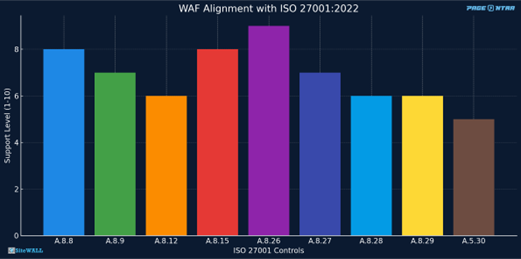
Figure 4: WAF Alignment with ISO 27001 – Diagram mapping WAF features to A.8 controls.
A.8.8 — Management of Technical Vulnerabilities
- Objective: Mitigate vulnerabilities to prevent exploitation.
WAF Role: Provides virtual patching for CVEs (e.g., Log4Shell) using managed rulesets to block exploit patterns. For example, SiteWALL integrates vulnerability scanning with automated virtual patching to detect and mitigate unpatched vulnerabilities in real time, reducing exposure until source code fixes are applied.
A.8.9 — Configuration Management
- Objective: Ensure secure system configurations.
- WAF Role: Enforces headers like HTTP Strict Transport Security (HSTS) and Content Security Policy (CSP).
- Configuration: Enable HSTS with Strict-Transport-Security: max-age=31536000.
A.8.12 — Data Leakage Prevention
- Objective: Prevent unauthorized data disclosure.
- WAF Role: Blocks sensitive data (e.g., PII, credit card numbers), supporting PCI DSS 6.6, HIPAA §164.308, and GDPR Article 32.
- Configuration: Use regex (e.g., \b[A-Za-z0-9._%+-]+@[A-Za-z0-9.-]+\.[A-Z|a-z]{2,}\b for emails) to block outbound PII.
A.8.15 — Logging
- Objective: Record activities for incident detection.
- WAF Role: Generates logs (e.g., 2025-07-21T12:32:00Z [BLOCK] SQLi attempt: UNION SELECT) and streams to SIEM/SOAR for real-time analysis.
- Configuration: Enable full request/response logging; integrate with Splunk or QRadar.
A.8.26 — Application Security Requirements
- Objective: Enforce application security.
- WAF Role: Blocks OWASP Top 10 threats (detailed in “WAF Functionality”). Blocks OWASP Top 10 threats (e.g., A03:2021—Injection, A07:2021—XSS). Solutions like SiteWALL provide comprehensive OWASP Top 10 protection, leveraging AI/ML to detect and block threats like SQL injection and XSS in real time
- Configuration: Use managed rulesets; tune for specific apps to minimize false positives.
A.8.27 — Secure System Architecture
- Objective: Design defense-in-depth systems.
- WAF Role: Acts as a perimeter control, complementing IAM and encryption.
- Configuration: Deploy WAFs at API gateways or CDN edges.

Figure 5: WAF Defense-in-Depth – Diagram showing WAFs in a layered security architecture.
A.8.28 — Secure Coding
- Objective: Minimize coding vulnerabilities.
- Configuration: Enable rules for parameter tampering; validate with SAST findings.
- Misconfiguration Risk: Over-reliance on WAFs without code fixes. Mitigation: Conduct regular code reviews and integrate WAF logs into development feedback (A.6.3).
A.8.29 — Security Testing
- Objective: Validate controls before deployment.
- WAF Role: Simulates attacks in CI/CD pipelines using DAST tools to test rules (e.g., XSS attempts).
- Configuration: Enable testing mode to log simulated attacks without blocking.
- Misconfiguration Risk: Unvalidated rules causing false positives. Mitigation: Tune rules in development environments using DAST results.
A.5.30 — ICT Readiness for Business Continuity
- Objective: Ensure system availability.
- WAF Role: Mitigates DDoS and bot attacks.
- Configuration: Set rate-limiting to 100 requests/minute per IP.
Common WAF Misconfigurations and Mitigations
- Permissive Rules: Allow exploits (A.8.8). Mitigation: Enable strict signatures; test with DAST (e.g., simulate SELECT * FROM users).
- Disabled Headers: Expose vulnerabilities (A.8.9). Mitigation: Audit HSTS/CSP settings.
- Poor Regex Patterns: Miss PII leaks (A.8.12). Mitigation: Validate patterns (e.g., test credit card regex with DAST).
- Incomplete Logging: Misses incidents (A.8.15). Mitigation: Enable full logging.
- False Positives: Impact usability (A.8.26). Mitigation: Tune rules using traffic analysis.
- Bypass Paths: Expose endpoints (A.8.27). Mitigation: Enforce WAF on all traffic.
- Over-Reliance: Ignores code fixes (A.8.28). Mitigation: Use SAST/DAST for permanent fixes.
- Aggressive Rate-Limiting: Disrupts users (A.5.30). Mitigation: Adjust thresholds (e.g., 200 requests/minute for high-traffic apps).
Addressing Emerging Threats
WAFs counter evolving threats like AI-driven botnets and zero-day exploits using advanced features:
- AI-Driven Bots: Enable bot management with challenge-response and device fingerprinting.
- Anomaly Traffic: Use machine learning to detect spikes (e.g., sudden 500 requests/minute from one IP).
- Rapid Payloads: Auto-update rules via threat intelligence feeds.
- Formjacking: Enable script integrity checks to block form tampering.
- Zero-Day Exploits: Enforce default-deny policies and strict traffic profiling.
Addressing Emerging Threats
Effectively defending against AI-driven cyberattacks with Web Application Firewalls (WAFs) requires a proactive, layered, and adaptive approach to keep pace with the evolving threat landscape. WAFs counter threats like AI-driven botnets and zero-day exploits using advanced features. The table below outlines recommended WAF implementations:
Threat Feature | WAF Implementation |
AI-Driven Bots | Enable bot management, challenge-response, device fingerprinting |
Anomaly Traffic Patterns | Activate and tune ML-based anomaly modules. |
Rapidly Evolving Payloads | Schedule auto-updates for threat intel and managed rules |
Script/Formjacking | Enable script integrity checks to block form tampering. |
Zero-Day/Unknown Vectors | Enforce default-deny, strict traffic profiling, designate responses for anomalies |
Example: A retail platform mitigated an AI-driven botnet using WAF bot detection and challenge-response, reducing malicious traffic and securing their web application platform. (A.8.8).
Case Study: Retail Botnet Attack
In 2024, a retail platform faced an AI-driven botnet attempting to scrape customer data, exploiting weak API authentication. Deploying a cloud-based WAF with bot detection and automated rate-limiting blocked all malicious traffic, aligning with A.8.8 and A.8.26. Logs streamed to a SIEM system enabled rapid incident response, supporting A.8.15.
Cross-Standard Compliance
Standard | Requirement | WAF Role |
PCI DSS 6.6 | Protect public-facing apps | Blocks OWASP Top 10 (A.8.26) |
HIPAA §164.308 | Risk management | Mitigates threats, logs incidents (A.8.15) |
GDPR Article 32 | Data protection | Prevents PII leaks via regex filters (A.8.12) |
WAFs support specific technical requirements, not overall certification.
Benefits of WAFs
- Security: Protects against OWASP Top 10 and emerging threats.
- Compliance: Supports ISO 27001, PCI DSS, HIPAA, GDPR.
- Monitoring: Integrates with SIEM/SOAR for real-time alerts.
- DevSecOps: Complements SAST/DAST in CI/CD pipelines.
- Cost Savings: Prevents losses from breaches.
Practical Implementation Steps
- Rules: Enable OWASP Top 10 protections (e.g., SQL injection rules for UNION SELECT).
- Monitoring: Stream logs to SIEM/SOAR (e.g., Splunk) for incident response (A.8.15).
- DevSecOps: Integrate WAF testing into CI/CD using DAST to simulate attacks (A.8.29).
- Updates: Update rules quarterly with threat intelligence (A.8.8).
- Documentation: Record configurations and logs in SoA/RTP for audits (Clause 6.1.3).
- Training: Train staff on WAF management and log analysis (A.6.3).
Limitations
- WAFs complement, but don’t replace, secure coding (A.8.28).
- Require tuning to avoid false positives or latency (e.g., high-traffic apps may experience delays).
- Need SAST/DAST/RASP for comprehensive coverage.
- Demand organizational (A.5) and people (A.6) controls.
Conclusion
WAFs, such as SiteWALL, AWS WAF, and ModSecurity, are integral to ISO/IEC 27001:2022 compliance, supporting controls like A.8.8, A.8.15, and A.8.26 through robust protection, logging, and DevSecOps integration. SiteWALL’s integrated vulnerability scanning, automated virtual patching, and OWASP Top 10 protection enhance compliance, particularly for organizations needing rapid deployment and real-time threat mitigation. By leveraging machine learning and threat intelligence, WAFs address emerging threats like AI-driven botnets, ensuring audit success and cross-standard compliance (PCI DSS, HIPAA, GDPR) as of July 30, 2025.
References
- ISO/IEC 27001:2022. https://www.iso.org/standard/27001
- ISO/IEC 27002:2022. https://www.iso.org/standard/75652
- OWASP Top 10 — 2021. https://owasp.org/Top10/
- PCI DSS v4.0. (2022). https://www.pcisecuritystandards.org/document_library/
- HIPAA Security Rule. https://www.hhs.gov/hipaa/for-professionals/security/index.html
- GDPR. https://eur-lex.europa.eu/eli/reg/2016/679/oj
- SiteWALL Web Application Firewall. https://www.sitewall.net