
IRDAI Cybersecurity Guidelines 2026: Why WAF Is No Longer Optional for Indian Insurers
A clause-by-clause analysis of Section 2.11 (3.4(7)) — what the regulation actually says, what your auditor will actually check, and how to choose a WAF that will pass.
1. WAF deployment is now a binding “shall” requirement under IRDAI Section 2.11, clause 3.4(7). Verified in circular IRDAI/GA&HR/CIR/MISC/51/4/2026 dated 6 April 2026, effective from FY 2026-27. 2. The WAF must inspect all traffic — including encrypted HTTPS — through architectural placement or decryption. The clause does not provide an exemption for encrypted traffic. 3. APIs are explicitly inside the same security testing umbrella (Section 2.16, clause 3.5.1(6)). 4. Auditors check WAF compliance through the NIST Cybersecurity Framework lens — specifically PR.PT, PR.DS, and DE.CM controls in Annexure III. Internal control inventories need to be mapped that way. 5. Many general-purpose WAFs do not satisfy six specific architectural and operational requirements that the regulation creates. This article walks through them. |
Read this in context
This article is the WAF-specific deep-dive within a larger 175-page, 347-control regulatory framework. For the complete picture of governance, applicability, the audit framework, and what changed in V2.0 versus the 2023 guidelines, see the companion briefing in this series: “IRDAI Cybersecurity Guidelines 2026: The Complete CXO Briefing.”
This article assumes you understand that broader picture and goes deep on one specific clause: Section 2.11, sub-clause 3.4(7) of the guidelines, which mandates WAF deployment. Everything below — the regulatory language, the audit lens, the evaluation criteria, and the SiteWALL mapping — is built around that single clause and its operational consequences.
What Section 2.11 clause 3.4(7) actually says
Section 2.11 of the IRDAI guidelines covers Network Security. Within the External Networks subsection (clause 3.4), sub-clause 7 contains the WAF mandate. The exact regulatory language imposes four distinct obligations on every regulated entity:
First, organisations shall protect web applications by deploying Web Application Firewalls. The verb “shall” is the same non-negotiable word used throughout the 175-page document as mandatory language. There is no “should,” no “may,” no “where appropriate.”
Second, the WAF must inspect all traffic flowing to the web application for common web application attacks. The word “all” is precise. Partial inspection — a WAF that handles HTTP but bypasses HTTPS, or a WAF that protects only the customer-facing portal but not the broker self-service application — does not satisfy the clause.
Third, encrypted traffic is not exempt. If the traffic is encrypted, the WAF must either sit behind the encryption termination point (so it sees decrypted traffic by architectural placement) or be capable of decrypting the traffic for analysis itself. HTTPS is now the default for every customer-facing insurance application, which means the encrypted-traffic clause applies to essentially every web application a regulated entity operates.
Fourth, the regulation closes the only remaining alternative path. If neither inline placement behind the encryption termination point nor decryption is feasible, a host-based web application firewall must be deployed. In effect, the clause provides for application-layer protection in every scenario it contemplates. For non-web applications, specific application firewalls must be deployed where such tools are available.
This clause is unchanged from the 2023 framework. What is new in 2026 is everything around it: the strengthened governance, the formalised audit structure, the 12-month gap closure timeline, the Board-level reporting of non-conformities, and the explicit “shall strictly adhere from the current financial year” language in the cover circular. The clause is the same. The enforcement framework is materially stronger.
Why Layer 7 protection matters
Network firewalls operate at OSI Layers 3 and 4. They see IP addresses, TCP and UDP ports, and protocol headers. They are good at blocking traffic from known-bad IPs, restricting access to specific ports, and enforcing network segmentation. They are not designed to understand the contents of an HTTP request, the structure of a JSON payload, or the logic of an authentication flow.
Modern attacks against insurance platforms operate at Layer 7. SQL injection against a quote engine. Cross-site scripting in a claims intake form. Credential stuffing against a customer login. Server-side request forgery in a document upload feature. Business logic manipulation in a policy issuance API. API abuse to scrape rate cards. None of these attacks can be detected, let alone blocked, by a Layer 3 or Layer 4 control. They require a security control that understands the application protocol, the application semantics, and the application data flow.
The insurance industry attack surface is structurally Layer 7. Customer portals, agent self-service, broker platforms, policy issuance APIs, claims intake systems, payment processing integrations, document upload workflows, KYC verification flows — every one of these touches sensitive policyholder data, every one of these is internet-facing, and every one of these is built on web application protocols. The mandate in Section 2.11 addresses this reality directly: the insurance industry’s primary attack surface extends well beyond the network perimeter.
You cannot protect insurance applications with controls designed for network packets.
How auditors actually check WAF compliance
This is the section that most commentary on the IRDAI guidelines misses, because it requires reading Annexure III of the official release package. The Annexure III auditor’s report — the document the CERT-In empanelled audit firm uses to score your compliance — is structured around the NIST Cybersecurity Framework function codes, not around the IRDAI section numbers in the 175-page guideline document.
Critical insight Your auditor will not arrive with a checklist organised by IRDAI Section 2.11, 2.16, 2.18. They will arrive with Annexure III, organised by NIST function codes. In practice, WAF-related evidence is typically reviewed through controls under PR.PT, PR.DS, and DE.CM, depending on how the organisation has implemented monitoring, protection, and logging. If your internal evidence is organised by IRDAI section number, you will spend the audit engagement remapping evidence on the fly — even if your underlying controls are sound. |
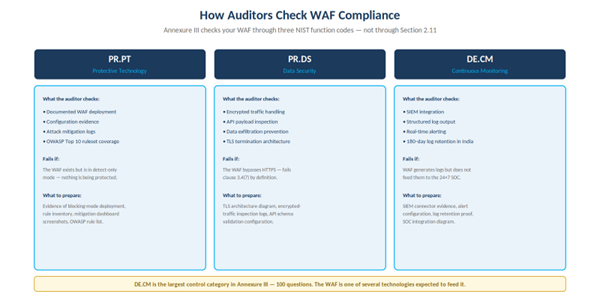
The three NIST function codes that govern WAF compliance specifically are:
PR.PT — Protective Technology
Does the deployed technology block known attack patterns? The auditor checks for documented WAF deployment, configuration evidence, attack mitigation logs, and the OWASP Top 10 ruleset coverage. A detect-only deployment creates a weak compliance posture because the control is observing attacks rather than clearly blocking them.
PR.DS — Data Security
Does the WAF protect data in transit and at rest as it crosses application boundaries? This includes encrypted traffic handling, API payload inspection, and data exfiltration prevention. A WAF that bypasses HTTPS creates an immediate gap under PR.DS, given the clause 3.4(7) requirement that encrypted traffic not be exempt.
DE.CM — Continuous Monitoring & Detection
Is the WAF generating monitorable telemetry that flows into the 24×7 SOC? The auditor checks for SIEM integration, structured log output, real-time alerting, and 180-day log retention within Indian jurisdiction. A WAF that generates logs without feeding them into the 24×7 SOC creates an evidentiary gap the auditor will flag under DE.CM. DE.CM is the largest single control area in Annexure III with 100 individual control questions — the WAF is one of several technologies expected to feed it.
Annexure III scores each control on two dimensions: whether the control is designed adequately and whether it is operating effectively. A WAF that is documented but not operating earns High or Medium. A WAF fully operating with evidence earns Complied. The risk score is then computed by formula — Risk Mark = (H × 3) + (M × 2) + (L × 1) + (C × 0) — and a worsening Risk Mark on PR.PT or DE.CM is visible to the Board, the ISRMC, and IRDAI.
There is one further dimension the audit applies to WAF: the 30-day high-risk remediation expectation under Section 2.16, clause 3.5.1(9). When a VAPT report identifies a high-risk vulnerability in a web application, that vulnerability should be remediated within 30 days. For complex business logic flaws, that timeline is operationally impossible without compensating controls. Virtual patching at the WAF layer becomes the only practical bridge — and the auditor will look for evidence that the bridge exists.
Six things your WAF must do to pass the audit
The regulation does not prescribe specific products. It defines architectural and operational capabilities. Six of these capabilities are non-negotiable for any WAF that will satisfy the IRDAI audit.
This is the point where WAF selection stops being a product comparison and becomes a compliance and architecture decision.
1. Inspect all traffic — including encrypted
The clause is precise: all traffic. A WAF that only inspects HTTP and bypasses HTTPS does not satisfy clause 3.4(7). The WAF must either sit behind the TLS termination point (so it inherits decrypted traffic by placement) or decrypt traffic itself for inspection. HTTPS is the default for customer-facing insurance applications, which means TLS handling is the rule, not the exception.
2. Cover APIs as first-class attack surface
APIs are explicitly named in clause 3.5.1(6). Your WAF must inspect REST and SOAP traffic with dedicated rulesets and schema validation, not just HTML form submissions. A WAF that only understands traditional web forms will leave your policy issuance, claims intake, and broker integration APIs unprotected, and your audit incomplete.
3. Provide virtual patching for the 30-day window
The 30-day high-risk remediation expectation makes virtual patching operationally essential. When VAPT lands a high-risk finding, your development team has 30 days to analyse, fix, test in a production-mirroring environment (clause 3.5.1(4) requires this), deploy, and pass mandatory revalidation testing. For many complex vulnerabilities, this timeline is not achievable without a compensating control. The right WAF can deploy targeted blocking rules within hours, not days, of a VAPT finding.
4. Deploy inline in blocking mode from day one
A WAF in detect-only mode or shadow mode is collecting logs while attacks succeed. The clause says “shall protect” — it requires protection, not observation. The right WAF deploys inline in blocking mode from the moment it goes live, with policy tuning that allows legitimate traffic through while blocking attacks. Detection-only deployments may be useful for tuning in some environments, but they are not a sustainable IRDAI compliance posture.
5. Retain logs for 180 days within India
Section 2.16 clause 3.2(14) requires 180-day ICT infrastructure log retention within Indian jurisdiction. Commercial WAFs commonly treat log storage as a metered, separately-priced service — which becomes a recurring compliance line item. A WAF that includes 180-day log retention in the base license and stores logs in India by default eliminates a separate cost and simplifies audit evidence collection.
6. Generate audit-ready evidence mapped to NIST function codes
The auditor reviews evidence through Annexure III controls. The WAF should produce reports that map cleanly to PR.PT, PR.DS, and DE.CM — not just raw access logs. Commercial WAFs often fall short here and require manual evidence assembly, which is where audit preparation time silently expands. A WAF with NIST-mapped reporting cuts pre-audit preparation from weeks to days.
Solutions that combine API schema validation, one-click virtual patching, inline blocking from day one, included 180-day log retention, and NIST-mapped audit reporting cut audit preparation time by weeks and reduce the risk of a worsening Risk Mark.
Three implications most insurers will discover too late
The six evaluation criteria above are operational. The implications below are strategic — second-order consequences that are not written explicitly anywhere in the guidelines but will define which insurers pass their first audit cycle and which struggle.
1. Virtual patching becomes operationally mandatory
Walk through the 30-day sequence. A VAPT report arrives with a high-risk finding — say, a business logic flaw in a policy issuance API. The clock starts. Your development team needs to understand the vulnerability, write a fix, test it in a staging environment that mirrors production (clause 3.5.1(4) requires this), deploy to production, and run mandatory revalidation testing. All within 30 calendar days. For a complex business logic flaw, this timeline is frequently not achievable within that window.
The only practical way to meet the timeline is to deploy a runtime protection layer — a WAF rule, a virtual patch — that blocks exploitation while the permanent fix is developed. The regulation does not use the phrase “virtual patching.” But the timeline makes it operationally inevitable. CISOs without a virtual patching capability in place are likely to experience this pressure on the first VAPT cycle of FY 2026-27.
2. Your auditor will arrive with a NIST checklist, not an IRDAI section list
This is the central insight of the entire two-article series. Internal compliance teams often organise their evidence around IRDAI section numbers. The auditor will not. The Annexure III audit framework is structured by NIST CSF function codes, and your WAF evidence will be checked under PR.PT, PR.DS, and DE.CM. CISOs who can hand the auditor a WAF report already mapped to those codes will close the audit in days. CISOs who cannot will spend weeks remapping evidence under audit pressure.
3. Sub-vendor WAF posture is now your audit problem
The new sub-outsourcing clause (3.2(11)) and the vendor security requirements under Section 2.14 mean that an insurer’s compliance posture extends across the entire vendor and sub-vendor chain. Consider a realistic scenario: your TPA outsources claims processing to a smaller technology firm. That firm runs a web application for claims intake. That web application has no WAF, no VAPT, no secure code review. A breach occurs. The audit finding does not land on the sub-contractor’s desk. It does not land on the TPA’s desk either. It lands on yours.
Section 2.14 clause 3.2(6) mandates right-to-audit clauses in all vendor contracts. The insurer is responsible for ensuring compliance across the chain. Visibility into vendors’ web application security posture — let alone their sub-contractors’ — is a prerequisite to Year 1 compliance, not a nice-to-have. The sub-outsourcing clause will surface uncomfortable conversations across the next twelve months of vendor renewals.
Compliance used to be checklist-driven. IRDAI 2026 has made it runtime-driven — and the audit clock is already running.
How SiteWALL maps to the WAF mandate
SiteWALL WAF, by PageNTRA Infosec, was built for exactly this category of regulatory expectation. The most important deployment characteristic to understand is this: SiteWALL is deployed in inline blocking mode from day one. That means real-time protection for all web applications from the moment the service goes live — not a detection-only shadow deployment that leaves applications exposed while policies are tuned. Legitimate traffic passes through; attacks are blocked as they arrive. This is what the “shall protect” language in clause 3.4(7) requires.
On the host-based fallback question that comes up in audit conversations: SiteWALL is a cloud-delivered WAF with built-in DR redundancy and an uptime guarantee. For environments where inline deployment and traffic inspection are feasible, SiteWALL’s cloud architecture is designed to meet the primary path contemplated by the clause. In environments where those conditions are not met, organisations should assess whether additional host-based controls are required under the clause 3.4(7) fallback provision.
Below is how SiteWALL maps to the application security obligations the IRDAI framework creates, organised into five functional groups.
1. WAF Deployment (Section 2.11) — inline real-time protection from day one
Cloud-delivered reverse proxy architecture inspecting all inbound traffic. Inline blocking from day one. Full HTTPS handling at the WAF layer through TLS termination. Built-in DR redundancy and uptime SLA. OWASP Top 10 mitigation in real time. Geolocation blocking, custom port support, HTTP/2, WebSocket support.
2. API Security (Section 2.16, clause 3.5.1(6))
Dedicated API protection module with REST and SOAP inspection, schema validation, and detection of API-specific abuse patterns including credential stuffing, scraping, and business logic manipulation.
3. Testing, virtual patching, and the 30-day window (Section 2.16, clause 3.5.1(9))
Targeted virtual patching capability that allows WAF rules to block exploitation of specific vulnerabilities within hours of a VAPT finding. SiteWALL also includes 12 vulnerability assessments per application per year — six times the IRDAI minimum cadence — giving CISOs a continuous view of their attack surface between formal audit cycles.
4. Monitoring, logging, and audit-ready evidence (Section 2.16)
Free 180-day WAF log retention included in the base license, stored within Indian jurisdiction — supports the 180-day log retention requirement at the WAF layer (clause 3.2(14)). Native SIEM integration with structured alert data ready for ingestion into the 24×7 SOC. Supports preparation of audit evidence aligned to the NIST-structured Annexure III review (PR.PT, PR.DS, DE.CM). Built-in incident monitoring and incident reports that support the 6-hour CERT-In reporting obligation under Section 2.10.
5. Additional resilience-enhancing capabilities
Beyond the four IRDAI-mandated areas above, SiteWALL also provides a set of capabilities that strengthen the overall application-layer security posture without being explicitly named in the WAF clause. These include cloud-based architecture with built-in redundancy and load balancing, AI/ML-based bot detection, application-layer DDoS protection with automated rate limiting, malware scanning including file upload protection, web shell detection (a unique SiteWALL capability), and defacement detection. Application-centric threat intelligence with attack feeds and daily signature updates from the SiteWALL research team rounds out the stack.
The condensed mapping table below summarises how each IRDAI control area maps to a specific SiteWALL capability — designed to be screenshot-able for compliance teams and audit preparation.
IRDAI Control | Section | SiteWALL Capability |
WAF Deployment (“shall”) | 2.11, 3.4(7) | Cloud WAF deployed inline in blocking mode from day one |
Real-time inline protection | 2.11 | Inline blocking from day one — not detection-only or shadow mode |
Inspect ALL traffic incl. encrypted | 2.11, 3.4(7) | TLS termination at WAF layer — full HTTPS decryption built into the architecture |
Cloud architecture with redundancy | 2.11 / BCP | Cloud-delivered with built-in DR redundancy and uptime SLA — eliminates the need for any host-based fallback |
OWASP Top 10 mitigation | 2.11 | Real-time blocking of all 10 categories |
API protection | 2.16, 3.5.1(6) | Dedicated API protection module with REST/SOAP inspection and schema validation |
L7 DDoS protection | 2.11 | AI/ML automated rate limiting, zero manual intervention |
Bot detection | App security | AI/ML bot detection engine |
Malware scanning | 2.11 | File upload and advanced malware scanning |
Virtual patching (30-day bridge) | 2.16, 3.5.1(9) | Targeted WAF rules deployable per vulnerability finding within hours |
Vulnerability assessment | 2.16, 3.5.1(3) | 12 VA scans per application per year — 6x the IRDAI minimum |
180-day log retention (in India) | 2.16, 3.2(14) | Free 180-day WAF log storage — included in license |
SIEM integration for 24×7 SOC | 2.16 | Native SIEM integration with structured alert data |
Web defacement detection | Integrity monitoring | Proactive defacement alerting |
Web shell detection | Advanced threats | Unique web shell detection — catches persistent backdoors |
Incident monitoring & reporting | 2.10 (6-hr CERT-In) | Built-in incident monitoring + audit-ready incident reports |
Geolocation access controls | 2.11 | Geo-blocking rules at country/region level |
Audit-ready dashboard (NIST mapped) | Annexure III | Visibility, security, top 10, trends — evidence pre-mapped to NIST function codes |
The bottom line
IRDAI has made application-layer security a matter of law. Not a recommendation. Not a best practice. A regulatory obligation backed by Board-level accountability, CERT-In empanelled audited testing cycles, NIST-structured Annexure III scoring, and a 30-day remediation expectation that makes virtual patching operationally inevitable.
The organisations that will navigate this well are the ones that treat the regulation not as a compliance exercise but as an architecture decision. Build the WAF into your application delivery pipeline. Integrate it with your SOC. Use it to bridge the gap between VAPT cycles. Map your evidence to NIST function codes before your auditor arrives. Make application security part of how you ship software, not something you bolt on before an audit.
The organisations that will struggle are not the ones with the weakest WAF — they are the ones that delay the structural decision to deploy application-layer protection at all. By the time the first audit finding appears, the 30-day remediation clock is already running and the Risk Mark is already visible to the Board.
If your organisation does not have application-layer protection today, you are already behind the IRDAI compliance curve.
For the broader regulatory context
This article focuses on Section 2.11 clause 3.4(7) and the WAF mandate specifically. For the complete picture of the IRDAI 2026 framework — the 24 security domain policies, the 347-control NIST-structured audit, the V2.0 governance changes, the 3-tier intermediary classification, the auditor eligibility under Annexure IV, and the first 90-day CXO action plan — see the companion briefing in this series: “IRDAI Cybersecurity Guidelines 2026: The Complete CXO Briefing.”
Ready for your first IRDAI 2026 audit cycle? PageNTRA Infosec is the maker of SiteWALL, a cloud-delivered Web Application Firewall supports IRDAI 2026 framework. SiteWALL deploys inline in blocking mode from day one, inspects all traffic including encrypted HTTPS, includes 180-day log retention within Indian jurisdiction in the base license, and can support audit evidence preparation aligned to the NIST-structured Annexure III review. For the application-layer protection required by Section 2.11 clause 3.4(7), the monitoring obligations under Section 2.16, and the 30-day high-risk remediation window, SiteWALL is built to satisfy the audit on day one — not on day ninety.
Request a SiteWALL demo | Download the datasheet | Read the IRDAI Complete CXO Briefing
|
Sources and references
- IRDAI Information and Cyber Security Guidelines, Version 2.0, April 2026 (175 pages) — Section 2.11 clause 3.4(7) (page 101), Section 2.16 clauses 3.5.1(3), 3.5.1(6), 3.5.1(9), Section 2.10 clause 3.6, Section 2.14 clauses 3.2(6) and 3.2(11)
- Cover circular IRDAI/GA&HR/CIR/MISC/51/4/2026 dated 6 April 2026, signed by A. R. Nithiyanantham, Executive Director (GA & HR), IRDAI
- Annexure III — Auditors Report, structured by NIST Cybersecurity Framework function codes (PR.PT, PR.DS, DE.CM are the codes that govern WAF compliance)
Disclaimer: This article is for informational purposes and does not constitute legal or regulatory advice. Organisations should consult qualified legal counsel and CERT-In empanelled or Annexure IV-eligible audit firms for specific compliance requirements. All clause references and quotations are taken directly from the official IRDAI release package dated 6 April 2026.