

Understanding DDoS Attacks: Types, Impact, and Network Protection Strategies
Cyberattacks occur globally every 39 seconds, with distributed denial of service (DDoS) attacks being among the most destructive. With businesses depending more and more on digital platforms, the stakes are higher than ever. However, what are DDoS attacks precisely, and why have they grown to pose such a serious risk to businesses throughout the globe?
We will go deeply into the nature of denial-of-service (DDoS) assaults in this blog, examine the various kinds that can cause havoc on your network, talk about the possible effects on your business, and comprehend the reasons behind these attacks. You’ll be in a better position to shield your company from the monetary losses, harm to your reputation, and operational difficulties that frequently follow when you are aware of these variables.
What is a DDoS Attack?
Imagine trying to enter a popular concert venue, but the entrance is blocked by a massive crowd, making it impossible for you to get in. This is exactly how a DDoS attack works—overwhelming a server with so much traffic that legitimate users can’t access it. But how does this actually happen?
A Distributed Denial of Service (DDoS) attack is a malicious attempt to disrupt the normal functioning of a target server, service, or network by overwhelming it with a flood of internet traffic. Unlike a regular Denial of Service (DoS) attack, which originates from a single source, a DDoS attack uses multiple compromised devices, often spread globally, to launch an assault simultaneously. These devices, usually part of a botnet, bombard the target with requests, overwhelming its resources and rendering it unavailable to legitimate users.
Understanding the OSI Model
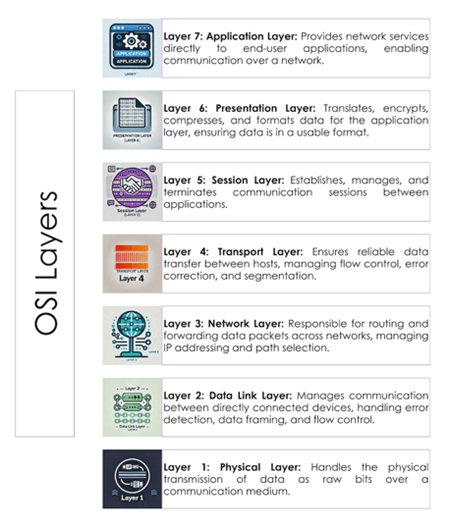
It’s critical to comprehend the OSI (Open Systems Interconnection) concept in order to completely comprehend how DDoS attack’s function. A computer or communication system’s operations are standardized into seven different levels by means of this conceptual framework: Physical, Data Link, Network, Transport, Session, Presentation, and Application. In controlling data transmission, each tier has distinct duties, and DDoS attacks might concurrently target one or more layers.
Summary of DDoS Attack Layers
DDoS attacks don’t just target one part of a network—they can strike at multiple levels, making them particularly hard to defend against. Here’s a quick guide to the layer’s most commonly under siege.
Understanding the various layers of the OSI model helps in recognizing where DDoS attacks can occur:
Layer | Type of Attack | Description | Example Attacks |
Layer 3 | Network Layer DDoS | Overwhelms network devices with high traffic volumes, leading to network congestion. | ICMP flood, Smurf attack, Fraggle attack |
Layer 4 | Transport Layer DDoS | Exploits transport protocols, overwhelming systems with connection requests, causing resource exhaustion. | SYN flood, UDP flood, ACK flood |
Layer 7 | Application Layer DDoS | Overloads specific applications by sending large volumes of legitimate-looking requests. | HTTP flood, Slowloris attack, RUDY attack |
Types of DDoS Attacks
Not all DDoS attacks are created equal. From overwhelming servers with bogus requests to exploiting specific network vulnerabilities, attackers have a variety of tools at their disposal. Let’s explore the most common types you should be aware of.
Recognizing the various forms DDoS attacks can take is the first step in building a robust defense. Here’s a breakdown of the primary types of attacks categorized by the OSI layer they target:
Category | Attack Type | Description |
Network Layer (Layer 3) Attacks | SYN Flood | Exploits the TCP handshake process by sending a flood of SYN requests, causing the server to use resources to handle these half-open connections. |
UDP Flood | Involves sending a high volume of UDP packets to random ports, forcing the target to check for applications at those ports, leading to resource exhaustion. | |
ICMP Flood (Ping Flood) | Overwhelms the network with ICMP Echo Requests (ping), consuming bandwidth. | |
Smurf Attack | Spoofs the IP address of the target and sends ICMP Echo requests to a network, causing all devices to respond back to the target, overwhelming it. | |
Fraggle Attack | Similar to a Smurf attack but uses UDP instead of ICMP to direct traffic to the target. | |
Transport Layer (Layer 4) Attacks | RST Flood | Sends numerous TCP Reset (RST) packets to terminate existing connections, causing service disruption. |
ACK Flood | Overwhelms networks by sending numerous TCP ACK packets, consuming bandwidth and resources. | |
Jenkins Flood | Exploits vulnerabilities in Jenkins servers to amplify traffic through UDP multicast services, generating massive traffic. | |
Application Layer (Layer 7) Attacks | HTTP Flood | Overloads web servers by sending high volumes of HTTP GET or POST requests, exhausting server resources. |
Slowloris | Maintains multiple open connections by sending partial HTTP requests, preventing the server from closing them. | |
RUDY (R U Dead Yet?) | Slowly sends long-form HTTP POST requests to keep connections open, consuming server resources. | |
DNS Amplification | Uses small DNS queries to trigger large responses, overwhelming the target’s network. | |
HTTP/2 Rapid Reset Attack | Leverages HTTP/2 protocol weaknesses by sending numerous streams that are quickly reset, overloading the server. | |
HTTP/2 Continuation Frame Attack | Exploits HTTP/2 protocol vulnerabilities by sending improperly handled frames, causing out-of-memory or CPU exhaustion. | |
DNS-Based Attacks | DNS Floods | Involves directing a high volume of DNS requests to the target to consume network resources. |
DNS Amplification | Uses a small query to trigger a large response from DNS servers, overwhelming the target. | |
IoT-Based Attacks | Botnet Attacks | Utilize compromised IoT devices or high-performance servers to generate massive volumes of traffic directed at the target (e.g., the Mozi Botnet using vulnerabilities in routers). |
Hybrid and Multi-Vector Attacks | Combination Attacks | Use multiple attack vectors (e.g., SYN floods and HTTP floods) simultaneously to exploit different vulnerabilities and complicate mitigation efforts. |
Amplification Attacks | NTP Amplification | Exploits Network Time Protocol servers to amplify traffic volume sent to the target. |
Memcached Amplification | Leverages publicly accessible Memcached servers to generate massive amounts of traffic directed at the target. | |
High-Performance Botnets | Mozi Botnet | Utilizes high-performance devices like Virtual Private Servers (VPS) instead of low-power IoT devices to launch large-scale attacks. |
Emerging and Sophisticated Attack Types | Pulse Attacks | Conduct short bursts of high-intensity traffic that are difficult to detect due to rapid start and stop nature. |
Random Subdomain Attacks | Flood DNS servers with requests for random subdomains, disrupting resolution processes. | |
Zero-Day DDoS Attacks | Exploit newly discovered or unpatched vulnerabilities to launch attacks. | |
IP Range Scanning Attacks | Target entire IP ranges, particularly common in financial and cloud sectors. | |
HTTP Version Targeting Attacks | Specific attacks target different HTTP versions (e.g., HTTP/2 or HTTP/3) by exploiting protocol-specific vulnerabilities. |
Motivations Behind DDoS Attacks
What drives someone to launch a DDoS attack? Is it about money, revenge, or making a political statement? Understanding the motives behind these attacks can help you better prepare your defenses.
Understanding the motivations behind DDoS attacks can provide deeper insights into why these assaults occur and how to better defend against them. The reasons for launching a DDoS attack can vary, but they generally fall into the following categories:
- Financial Gain: Cybercriminals often use DDoS attacks as part of extortion schemes, demanding ransom payments in exchange for halting the attack. These attacks can also be used to disrupt a competitor’s operations, leading to financial losses for the target and potential gains for the attacker.
- Political Activism (Hacktivism): DDoS attacks are commonly used by hacktivist groups to protest against governments, organizations, or individuals they perceive as unethical or unjust. These attacks are intended to make a political statement, disrupt services, and draw attention to their cause.
- Revenge or Personal Vendetta: Some DDoS attacks are motivated by personal grudges or revenge, where the attacker seeks to damage the reputation or operations of the target due to perceived wrongdoing.
- Geopolitical Tensions: Nation-states or politically motivated groups may use DDoS attacks as a form of cyber warfare to disrupt critical infrastructure, spread chaos, or weaken the adversary’s strategic position.
- Testing or Experimentation: In some cases, attackers may launch DDoS attacks simply to test their capabilities, experiment with new tools, or demonstrate their power within certain communities.
Understanding these motivations helps organizations recognize potential threats and tailor their defense strategies, accordingly, ensuring they are prepared for the different types of DDoS attacks they might face.
Understanding the Impact of DDoS Attacks
What would happen if your business went offline for an hour? How about a day? The financial and reputational damage from a DDoS attack can be staggering, and the impact goes far beyond just lost sales.
DDoS attacks can have devastating effects on businesses and entire networks. The primary consequences include:
- Service Outage: The immediate effect is the unavailability of services, which can lead to significant revenue loss, especially for online businesses.
- Reputational Damage: Frequent or prolonged outages can damage an organization’s reputation, leading to a loss of customer trust and potential long-term business losses.
- Financial Losses: Beyond the revenue loss from downtime, organizations may incur substantial costs related to mitigation, recovery, and legal fees.
- Operational Disruption: DDoS attacks can disrupt internal operations, particularly if they affect critical services or communication channels, leading to productivity losses.
“In 2023 alone, the average cost of a DDoS attack for businesses was $2.5 million, not including long-term reputational damage.”
Real-World Examples of DDoS Attacks
DDoS attacks aren’t just theoretical—they happen all the time, and their consequences are very real. Here are some of the most notable attacks from the past year and what they mean for businesses like yours.
DDoS attacks have evolved over the years, becoming more frequent and sophisticated. Here are some notable examples from recent years:
Year | Incident | Type | Details | Impacted Country |
2024 | Indonesian Gaming Site Attack | Application Layer Attack (HTTP/2 Rapid Reset) | An Indonesian gaming site was hit by a significant Layer 7 DDoS attack with 4.7 million requests per second, using the “HTTP/2 Rapid Reset” technique to overwhelm the server. | Indonesia |
2024 | Global Surge in DNS-Based Attacks | Network Layer Attack (DNS Amplification) | DNS-based DDoS attacks increased by 215%, with a 483% growth in attack size, representing over 21% of all network DDoS attacks. | Worldwide |
2024 | Manufacturing Sector Under Assault | Mixed Attack Types | The manufacturing sector saw a 308% increase in attack duration and a 200% increase in size, making it a prime target alongside healthcare. | United States, Europe |
2024 | AI-Driven DDoS Attacks | Various (AI-Enhanced Botnet Attacks) | AI-enhanced DDoS attacks have become more frequent and sophisticated, impacting sectors like telecommunications, education, and cloud services. | Multiple countries (Global Impact) |
2024 | Geopolitical Motivated Attacks | Layer 7 and Layer 3/4 Attacks | DDoS attacks driven by geopolitical tensions surged, particularly in Ukraine and Israel, targeting critical infrastructure. | Ukraine, Israel |
2023-2024 | OpAbabeel Campaign | Combined Network and Application Layer | Hacktivist groups targeted Indian government entities, judiciary, and educational institutes with DDoS attacks as part of a broader campaign against perceived injustices. | India |
2023 | OpIndia2.0 Campaign | Network Layer Attack (DDoS) | Indonesian hacktivists launched a DDoS campaign against 54 Indian government websites, driven by geopolitical tensions. | India |
Advanced Mitigation Strategies for DDoS Attacks
You know what DDoS attacks are and the damage they can cause. But what can you do to stop them? Here are some advanced strategies that have proven effective in keeping these threats at bay.
Knowing the types of attacks is only half the battle. To effectively protect your network, consider these advanced mitigation strategies:
- Traffic Scrubbing: Use scrubbing centers to filter out malicious data while allowing legitimate traffic. This is effective for mitigating high-volume attacks.
- Behavioral Analytics: Employ analytics tools to detect abnormal traffic patterns early and respond more quickly.
- Cloud-Based Mitigation: Utilize cloud-based DDoS protection services that dynamically scale resources to absorb and mitigate large-scale attacks, ensuring continued resilience against sophisticated threats.
DDoS Glossary
- Botnet: A network of compromised devices used to perform a DDoS attack.
- Traffic Scrubbing: The process of filtering malicious traffic from legitimate traffic.
- Amplification: A technique that exploits vulnerabilities to amplify attack traffic.
- Volumetric Attacks: Attacks that aim to consume bandwidth.
- Protocol Attacks: Attacks that exploit protocol vulnerabilities.
- Application Layer Attacks: Attacks targeting application-specific resources, typically at OSI Layer 7.
Call to Action
Can your business afford the downtime caused by a DDoS attack? If the answer is no, it’s time to take action. Here’s what you need to do right now to protect your network.
Take Action Now: With DDoS attacks becoming more frequent, larger, and costlier, there’s no time to delay. Executives and technical leaders must prioritize investments in advanced DDoS mitigation solutions to safeguard critical infrastructure and prevent significant financial and reputational losses. Explore the latest DDoS defense strategies, including traffic scrubbing, behavioral analytics, and cloud-based protection services, to build a resilient cybersecurity posture.
Learn more about how to protect your business from evolving Application DDoS threats by visiting SiteWALL for comprehensive security solutions.