
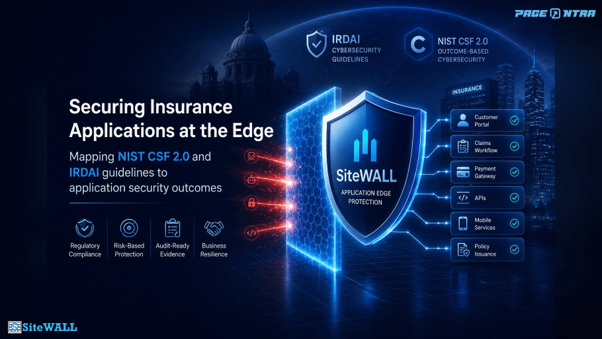
NIST CSF 2.0 and IRDAI Cybersecurity Guidelines: Mapping Web Application Security and How SiteWALL Delivers
A CXO-grade briefing for insurers, intermediaries, ISNPs, web aggregators, and insurance technology providers
IRDAI’s 2026 Information and Cyber Security Guidelines have changed the cybersecurity conversation for India’s insurance ecosystem. Issued as Version 2.0 on 6 April 2026 (circular ref IRDAI/GA&HR/CIR/MISC/51/4/2026) and effective from the current financial year (FY 2026-27), they replace the 2023 framework.
This is not only a compliance circular. It is a governance, assurance, and audit-readiness framework that expects regulated entities to protect critical information assets, demonstrate operational control effectiveness, and provide evidence that can stand up to independent audit scrutiny.
For CXOs, the most important point is this:
IRDAI defines the regulatory obligation. NIST CSF 2.0 provides the outcome-based cybersecurity structure. Web application security is where many of those obligations become operational. SiteWALL helps deliver and evidence those web application security outcomes.
Regulatory lens | Operational meaning |
IRDAI | Defines the obligation |
NIST CSF 2.0 | Structures the cybersecurity outcome |
Web application security | Converts the outcome into operational control |
SiteWALL | Provides protection, telemetry, and evidence at the application edge |
That sequence matters.
This article maps NIST CSF 2.0 and IRDAI expectations to web application security outcomes, then shows how SiteWALL supports them at the application edge.
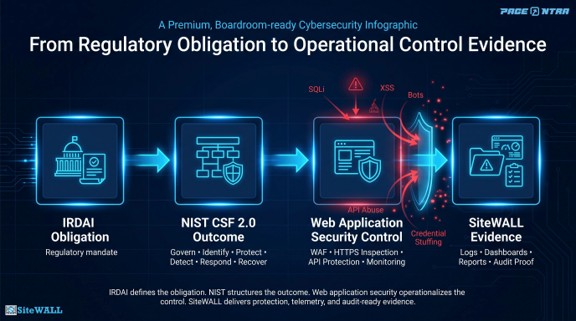
Figure 1. From regulatory obligation to operational control evidence: IRDAI defines the obligation, NIST CSF 2.0 structures the outcome, web application security operationalises the control, and SiteWALL delivers protection, telemetry, and audit-ready evidence
Why NIST CSF 2.0 and IRDAI must be read together
IRDAI’s 2026 Guidelines explicitly state that the applicability of the NIST Framework to all regulated entities is provided in Annexure I, while Annexure III contains the auditor’s report, audit summary, findings, non-compliances, risk rating, and audit checklist. The guidelines apply to insurers, Foreign Reinsurance Branches, and insurance intermediaries regulated by IRDAI, and they apply to data created, received, or maintained by regulated entities wherever those records are located and whatever form they take.
That structure has a direct operational implication.
A compliance team may naturally prepare evidence around IRDAI section numbers: Network Security, Monitoring and Logging, Third Party Service Providers, Cloud Security, Cyber Resilience, and so on. That is necessary, but it is not sufficient.
The audit view is different. The companion CXO briefing in this series highlights that the audit checks 347 controls organised around the NIST Cybersecurity Framework, not merely around IRDAI section numbers. It also warns that evidence libraries organised only by IRDAI sections can create audit-navigation friction.
For leadership teams, the practical message is clear:
Do not prepare only by IRDAI section number. Prepare by NIST outcome and IRDAI clause together.
That means evidence should be mapped to Govern, Identify, Protect, Detect, Respond, and Recover, while also showing the corresponding IRDAI section and control intent.
Why web application security is the convergence point
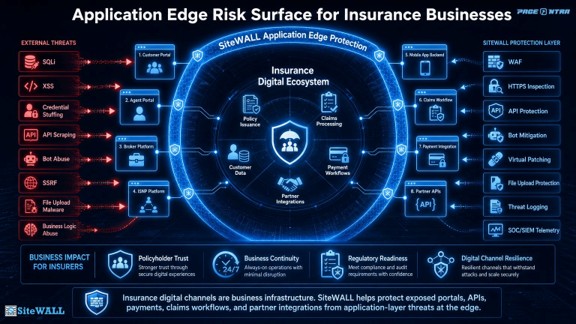
Figure 2. Application-edge risk surface for insurance businesses: customer portals, agent and broker platforms, claims workflows, payments, mobile backends, ISNP platforms, and partner APIs form exposed digital business infrastructure.
Insurance is now a digital business.
Customer portals, agent self-service platforms, broker applications, policy issuance systems, claims workflows, mobile backends, document upload journeys, payment integrations, ISNP platforms, and APIs are not peripheral systems anymore. They are business infrastructure.
They are also exposed.
The IRDAI WAF deep-dive explains the Layer 7 risk clearly: network firewalls operate at OSI Layers 3 and 4, where they see IP addresses, ports, and protocol headers. They are not designed to understand the content of an HTTP request, the structure of a JSON payload, or the logic of an authentication flow. Modern attacks against insurance platforms — SQL injection, cross-site scripting, credential stuffing, SSRF, API scraping, and business logic manipulation — operate at the application layer.
For a Board, CRO, CIO, CISO, or compliance head, the question is therefore not only:
Do we have a WAF?
The better question is:
Can we demonstrate that our internet-facing applications and APIs are identified, protected, monitored, logged, tested, and auditable under both NIST CSF 2.0 and IRDAI Cybersecurity Guidelines?
That is where SiteWALL becomes relevant.
What IRDAI says about WAF
Section 2.11, clause 3.4(7), is the most direct IRDAI requirement for Web Application Firewall deployment and application-layer traffic inspection.
The WAF deep-dive identifies four practical obligations from this clause. First, organisations must protect web applications by deploying Web Application Firewalls. Second, the WAF must inspect all traffic flowing to the web application for common web application attacks. Third, encrypted traffic is not exempt; the WAF must either sit behind the encryption termination point or be capable of decrypting traffic for analysis. Fourth, if inline placement or decryption is not feasible, a host-based WAF must be deployed.
This is important because the clause is not satisfied by a procurement record alone.
A weak implementation may still create audit exposure if the WAF protects only selected applications, bypasses HTTPS traffic, does not cover APIs, runs only in detect mode, or cannot produce logs and evidence for audit.
IRDAI expects more than WAF ownership. It expects protection, inspection, monitoring, and evidence.
How to read the mapping below
The mapping below uses NIST CSF 2.0 subcategory codes and IRDAI section references, with plain-English descriptions of control intent. These descriptions are not verbatim NIST text.
This mapping should be read as a control-support model, not as a claim that a WAF alone satisfies the full NIST CSF 2.0 or IRDAI Cybersecurity Guidelines.
A note on NIST versions. This mapping uses NIST CSF 2.0 subcategory codes such as PR.IR and PR.PS. Some IRDAI audit material may still reference earlier CSF 1.1 terminology such as PR.PT (Protective Technology). Where this occurs, organisations should maintain a crosswalk to the corresponding CSF 2.0 outcomes, particularly PR.IR, PR.PS, PR.DS, and DE.CM-related evidence, and confirm the exact NIST version referenced in Annexure I and Annexure III.
Directly supports means SiteWALL performs or produces the application-layer control outcome, such as blocking, HTTPS inspection, API inspection, logging, or evidence export.
Materially contributes means SiteWALL strengthens a broader customer-owned outcome, such as risk management, SOC monitoring, incident response, supplier governance, or audit readiness.
Mapping NIST CSF 2.0 and IRDAI Cybersecurity Guidelines to Web Application Security — and How SiteWALL Delivers
The following outcomes are not exhaustive. They represent the most relevant intersections between NIST CSF 2.0, IRDAI Cybersecurity Guidelines, and SiteWALL capabilities for web application security. Final compliance interpretation should be validated against the official IRDAI guideline text, the Annexure III audit checklist, and the appointed auditor. A detailed subcategory-level mapping workbook should be maintained separately for audit and implementation teams.
Outcome 1: Know which internet-facing applications are protected
NIST CSF 2.0 mapping: ID.AM-02 – Inventory of software, services, and systems: Organisations should understand which systems, platforms, applications, and services are in use. ID.AM-05 – Prioritisation of assets based on criticality: Applications should be prioritised based on business value, exposure, and operational importance.
IRDAI Cybersecurity Guidelines mapping: Section 2.2 – Asset Management: Requires information assets to be identified, owned, and managed. Section 1.8 – Risk Management: Requires risk assessment across business applications, systems, networks, vendors, and technology changes.
How SiteWALL supports: SiteWALL’s per-FQDN onboarding creates an explicit inventory of protected web applications. The application dashboard helps teams see which internet-facing applications are under protection and which still need onboarding.
Outcome 2: Identify vulnerabilities and application-layer risks
NIST CSF 2.0 mapping: ID.RA-01 – Vulnerabilities are identified and documented: Security weaknesses should be discovered and recorded. ID.RA-02 – Cyber threat intelligence is received and used: Threat information should inform risk decisions. ID.RA-03 – Internal and external threats are identified: Organisations should understand active threats relevant to their environment. ID.RA-05 – Threats, vulnerabilities, likelihood, and impact are used to understand risk: Application risk should be evaluated in business context.
IRDAI Cybersecurity Guidelines mapping: Section 2.16 – Monitoring, Logging and Assessment: Covers security assessment, testing, monitoring, and review of systems and applications. Section 1.8 – Risk Management: Requires risk assessment for business applications, information systems, networks, external service providers, major technology changes, and outsourced environments.
How SiteWALL supports: SiteWALL provides periodic vulnerability assessments, severity-based reporting, vulnerability tracking, and application-centric threat intelligence. This helps CISOs and risk teams identify exposed weaknesses and prioritise remediation.
Outcome 3: Control who and what can reach applications
NIST CSF 2.0 mapping: PR.IR-01 – Protective controls are implemented to manage risk: Organisations should use technical safeguards to protect systems, networks, and environments from unauthorised use. PR.AA-01 – Identities and credentials are managed for authorised users, services, and hardware: Access to security management systems should follow least-privilege principles.
IRDAI Cybersecurity Guidelines mapping: Section 2.3 – Access Control: Requires controlled access to information systems and information assets. Section 2.11 – Network Security: Requires protective network controls for external and internal connectivity.
How SiteWALL supports: SiteWALL supports application perimeter controls through IP allow/block lists, geolocation rules, custom port controls, API protection, and role-based access control for the management console.
Outcome 4: Protect web applications using WAF
NIST CSF 2.0 mapping: PR.IR-01 – Protective controls are implemented to reduce risk: Security controls should reduce exposure and prevent unauthorised or malicious activity. PR.PS-05 – Installation and execution of unauthorised software are prevented: Controls should prevent malicious code, exploit payloads, and unauthorised execution attempts from succeeding.
IRDAI Cybersecurity Guidelines mapping: Section 2.11 – Network Security, External Networks, Clause 3.4(7): Requires organisations to protect web applications by deploying Web Application Firewalls and inspecting traffic for common web application attacks.
How SiteWALL supports: SiteWALL delivers cloud-based Web Application Firewall protection in inline blocking mode, helping prevent OWASP Top 10 attacks, malicious payloads, bots, exploit attempts, and application-layer abuse before they reach the application.
Outcome 5: Inspect encrypted HTTPS traffic
NIST CSF 2.0 mapping: PR.DS-related data security outcomes – Data in transit should be protected and monitored where relevant to risk: Sensitive information moving across networks should be protected, and security controls should be able to inspect relevant traffic where required. DE.CM-01 – Networks and network services are monitored to find potentially adverse events: Traffic monitoring should detect suspicious or malicious activity.
IRDAI Cybersecurity Guidelines mapping: Section 2.11 – Network Security, Clause 3.4(7):
Encrypted traffic is not exempt from WAF inspection. The WAF must either sit behind the encryption termination point or be capable of decrypting traffic for analysis.
How SiteWALL supports: SiteWALL supports TLS termination and HTTPS inspection so malicious payloads hidden inside encrypted traffic can be inspected and blocked.
Outcome 6: Protect APIs as part of the application attack surface
NIST CSF 2.0 mapping: PR.IR-01 – Protective controls are implemented to reduce risk: API access paths should be protected like other application interfaces. DE.CM-01 – Networks and services are monitored: API traffic should be monitored for adverse activity. DE.AE-related outcomes – Adverse events are detected, analysed, and understood: API abuse patterns should be visible and actionable.
IRDAI Cybersecurity Guidelines mapping: Section 2.16, Clause 3.5.1(6) – Application and API security testing: APIs are included within the security testing and assessment umbrella, not treated as separate or lower-risk assets.
How SiteWALL supports: SiteWALL supports API protection through REST/SOAP inspection, schema validation, abuse detection, and controls against credential stuffing, scraping, automated misuse, and suspicious API behaviour.
Outcome 7: Block application-layer attacks before they reach the application
NIST CSF 2.0 mapping: PR.IR-01 – Risk is managed through protective safeguards: Known and unknown attack paths should be reduced through technical controls. PR.PS-05 –
Unauthorised software and malicious execution are prevented: Exploit payloads, malware, web shells, and attack traffic should be prevented from executing or reaching vulnerable components.
IRDAI Cybersecurity Guidelines mapping: Section 2.11 – Network Security: Requires security controls to protect external network-facing services and web applications. Section 2.16 – Monitoring, Logging and Assessment: Supports ongoing validation of control effectiveness.
How SiteWALL supports: SiteWALL provides OWASP Top 10 mitigation, signature-based detection, AI/ML behavioural analysis, bot mitigation, malware scanning, file upload protection, web-shell detection, and defacement detection.
Outcome 8: Maintain application availability under attack
NIST CSF 2.0 mapping: PR.IR-03 – Mechanisms are implemented to achieve resilience requirements: Controls should help systems continue operating under stress or attack. PR.IR-04 – Adequate resource capacity is maintained to ensure availability: Organisations should plan for resilience against load, abuse, and disruption.
IRDAI Cybersecurity Guidelines mapping: Section 1.3 – Continuity principle (Principle 7): Organisations must demonstrate continuity and resilience from business and technology perspectives. Section 2.13 – Business Continuity Management and Disaster Recovery: Requires continuity planning and recovery capability. Section 2.20 – Cyber Resilience: Requires a cyber security management programme that continuously delivers intended outcomes despite adverse cyber events, structured around identification, protection, detection, response, and recovery. Section 2.11 – Network Security: Includes protection against network and traffic-based threats.
How SiteWALL supports: SiteWALL supports availability through cloud-delivered architecture, redundancy, application-layer DDoS protection, automated rate limiting, and controls against bot floods and abusive traffic patterns.
Outcome 9: Keep defences current as threats evolve
NIST CSF 2.0 mapping: PR.PS-01 – Configuration management practices are established and applied: Security configurations should be maintained and updated. PR.PS-02 – Software is maintained, replaced, and removed commensurate with risk: Exposures should be reduced as vulnerabilities emerge.
IRDAI Cybersecurity Guidelines mapping: Section 1.8 – Risk Management: Requires control review, risk treatment, and monitoring of control effectiveness. Section 2.16, Clause 3.5.1(9) – Timely remediation expectation: High-risk findings must be addressed within strict timelines — high-risk gaps must be remediated immediately and in no case beyond 30 days, followed by mandatory re-validation testing, making temporary exposure reduction important.
How SiteWALL supports: SiteWALL supports virtual patching, rule updates, signature updates, vulnerability-driven controls, and threat-intelligence-based tuning to reduce exposure while permanent code remediation is completed.
Outcome 10: Monitor web traffic continuously
NIST CSF 2.0 mapping: DE.CM-01 – Networks and network services are monitored: Continuous monitoring should identify attacks, anomalies, and potentially adverse events. DE.AE-02 – Potentially adverse events are analysed: Detected events should be reviewed and understood. DE.AE-07 – Cyber threat intelligence and contextual information are integrated into analysis: Detection should be enriched with threat context. DE.AE-08 – Incidents are declared when adverse events meet defined criteria: Security teams should have enough information to escalate events into incidents.
IRDAI Cybersecurity Guidelines mapping: Section 2.16 – Monitoring, Logging and Assessment: Requires monitoring, logging, and security assessment of information systems. Section 2.18 – Situational Awareness: Supports awareness of threats, vulnerabilities, attacks, and security events.
How SiteWALL supports: SiteWALL provides real-time traffic inspection, alerting, dashboards, threat intelligence, and SIEM-ready logs to support continuous monitoring and SOC visibility.
Outcome 11: Preserve logs and audit evidence
NIST CSF 2.0 mapping: DE.AE-03 – Information is correlated from multiple sources: Security events should be correlatable for investigation. DE.AE-04 – Estimated impact and scope of adverse events are understood: Logs should help determine what happened, where, and how serious it was. DE.AE-06 – Information on adverse events is provided to authorised staff and tools: Evidence should be available to SOC, security, and compliance teams.
IRDAI Cybersecurity Guidelines mapping: Section 2.16 – Monitoring, Logging and
Assessment: Requires security logs, monitoring evidence, assessment records, and review mechanisms. Annexure III – Audit Report and Checklist: Requires evidence to support audit findings, non-compliances, risk rating, and control effectiveness.
How SiteWALL supports: SiteWALL provides 180-day WAF log retention, attack logs, policy exports, dashboards, vulnerability assessment reports, incident records, and SIEM integration to support audit-ready evidence.
Outcome 12: Contain and mitigate attacks quickly NIST CSF 2.0 mapping: RS.MI-01 – Incidents are contained: Security events should be stopped from spreading or causing further damage. RS.MI-02 – Incidents are eradicated: Malicious activity should be neutralised. RS.MA-01 – Incident response is managed: Response actions should be coordinated. RS.MA-02 – Incident response is executed: Response plans should translate into action. RS.AN-06 – Actions are performed to understand and validate incidents: Investigation and triage should be evidence-based.
IRDAI Cybersecurity Guidelines mapping: Section 2.10 – Incident and Problem Management: Requires incident handling, escalation, root cause analysis, corrective action, and reporting. Section 2.16 – Assessment and remediation expectations: Supports timely remediation of vulnerabilities and security findings.
How SiteWALL supports: SiteWALL helps contain attacks through inline blocking, virtual patching, incident records, targeted WAF rules, and attack evidence that supports triage and remediation.
Outcome 13: Govern WAF supplier and third-party responsibility NIST CSF 2.0 mapping: GV.RR-02 – Roles and responsibilities are established and communicated: Accountability for cybersecurity activities should be clear. GV.SC-04 – Suppliers are known and prioritised by criticality: Third-party technology providers should be governed based on risk. GV.SC-05 – Supplier requirements are established and maintained: Security obligations should be contractually and operationally clear. GV.SC-07 – Supplier risks are monitored over the relationship lifecycle: Vendor performance and risk should be reviewed continuously. GV.OC-03 – Legal, regulatory, and contractual requirements are understood and managed: Supplier security should support regulatory obligations.
IRDAI Cybersecurity Guidelines mapping: Section 2.14 – Third Party Service Providers: Requires third-party service providers handling insurer data to maintain security controls at least as strong as the regulated entity’s expectations. It also strengthens accountability over outsourcing and sub-outsourcing. Section 1.3 – Trust principle: Partners, vendors, and service providers must demonstrate their ability to meet or exceed security requirements.
How SiteWALL supports: SiteWALL supports supplier governance through documented RACI, SLA-backed service commitments, support workflows, operational responsibility boundaries, evidence packs, and audit-support documentation.
CXO takeaway A WAF should not be evaluated only as a security filter. In the IRDAI 2026 audit context, it should be evaluated as an application-edge control system that protects applications, inspects encrypted traffic, covers APIs, feeds SOC visibility, supports virtual patching, and produces evidence for control effectiveness. |
What the mapping tells CXOs
The mapping shows that web application security is not a single-control issue. It is a cross-functional control area touching asset visibility, risk assessment, protective technology, encrypted traffic inspection, API protection, continuous monitoring, logging, incident response, resilience, and supplier governance.
For CXOs, this makes WAF a control-effectiveness and evidence question, not only a security-tool decision.
The companion SiteWALL NIST CSF paper makes this distinction clearly: SiteWALL directly supports or materially contributes to CSF 2.0 outcomes primarily across Govern, Identify, Protect, Detect, and Respond, with limited contribution to selected Recover outcomes. It also produces auditable artifacts such as WAF policy exports, 180-day log archives, vulnerability assessment reports, incident records, SLA reports, and a documented RACI matrix.
That evidence trail is critical because regulators and auditors are not only asking whether a control exists. They are asking whether the control is designed adequately, operating effectively, and producing proof. The Annexure III audit makes this measurable. Each control is scored on whether it is designed adequately and operating effectively, and the result feeds a numeric Risk Mark calculated as (High × 3) + (Medium × 2) + (Low × 1) + (Complied × 0). The audit does not produce only a pass/fail narrative; it produces a number the Board, the ISRMC, and IRDAI can track year on year. A documented but non-operating WAF scores High or Medium; a fully operating WAF with evidence can support a Complied position. That is why the evidence trail directly affects the score, not just the narrative.
How SiteWALL delivers against the mapped outcomes
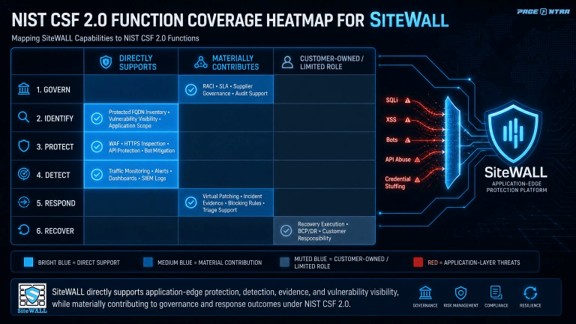
Figure 3. NIST CSF 2.0 function coverage heatmap: SiteWALL directly supports application-edge protection, detection, vulnerability visibility, and evidence generation, while materially contributing to governance and response outcomes.
- SiteWALL makes protected application scope visible
SiteWALL’s per-FQDN model creates a practical inventory of protected applications and helps identify gaps where portals, APIs, staging environments, or partner-facing systems are not yet onboarded.
- SiteWALL protects applications in blocking mode
IRDAI’s WAF clause is about protection, not passive observation.
SiteWALL is positioned as a cloud-delivered WAF deployed inline in blocking mode, inspecting traffic before it reaches the protected application.
- SiteWALL inspects encrypted traffic
Because HTTPS is standard for customer-facing insurance platforms, encrypted traffic cannot be treated as outside WAF scope.
SiteWALL supports TLS termination and HTTPS inspection so attack payloads inside encrypted traffic can be inspected and blocked.
- SiteWALL extends protection to APIs
Insurance platforms increasingly depend on APIs for policy issuance, claims workflows, payment integrations, customer mobile apps, broker connectivity, and third-party services.
SiteWALL’s API protection capabilities support REST/SOAP inspection, schema validation, and detection of API-specific abuse such as scraping, credential stuffing, automation misuse, and business logic manipulation.
Protecting web pages while ignoring APIs leaves the application security programme incomplete.
- SiteWALL helps reduce the patching gap
The most dangerous period after a vulnerability is discovered is the gap between identification and permanent remediation. Development teams need time to validate, fix, test, deploy, and revalidate code. Attackers do not wait for the release cycle.
SiteWALL supports virtual patching through targeted WAF rules that reduce exploitability while permanent remediation is completed.
- SiteWALL produces audit-ready evidence
SiteWALL also produces audit-ready evidence, including protected application inventory, WAF policy exports, attack logs, vulnerability assessment reports, virtual patch records, dashboards, incident records, SIEM integration evidence, SLA records, and RACI documentation.
This is central to the NIST and IRDAI audit model because control effectiveness must be demonstrated, not merely asserted.
Why evidence matters more than tool ownership
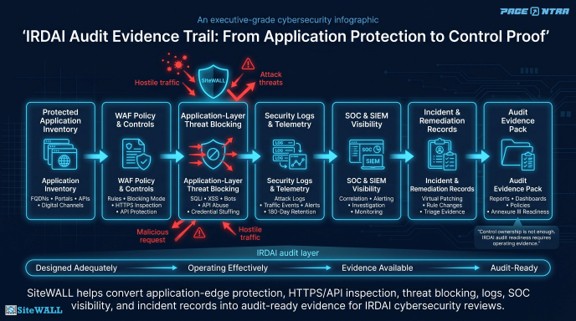
Figure 4. IRDAI audit evidence trail: application protection, WAF controls, threat blocking, logs, SOC/SIEM visibility, and incident records become audit-ready proof of control effectiveness.
A recurring mistake in regulated cybersecurity is confusing tool ownership with control effectiveness.
Owning a WAF is not the same as proving that applications are protected.
Owning a SIEM is not the same as proving that WAF telemetry reaches the SOC.
Owning vulnerability reports is not the same as proving exposure has been reduced.
Owning a policy is not the same as proving that the control operates.
The IRDAI audit model creates pressure for evidence. The WAF deep-dive notes that Annexure III is structured around NIST function codes and that WAF-related evidence is typically reviewed through protective technology, data security, and continuous monitoring lenses.
That makes the evidence trail from SiteWALL strategically valuable.
It helps answer audit questions such as:
Are all relevant internet-facing applications protected?
Is encrypted traffic inspected?
Are APIs covered?
Is the WAF operating in blocking mode?
Are logs retained and exportable?
Are attack events visible to SOC teams?
Are high-risk vulnerabilities virtually patched while permanent fixes are completed?
Is supplier accountability documented through RACI and SLA?
For CXOs, these are not technical questions alone. They are governance, audit-readiness, and business resilience questions.
What SiteWALL does not replace
This boundary is important for audit defensibility.
SiteWALL is not a replacement for an enterprise cybersecurity programme, Board-approved Information and Cyber Security Policy, CISO function, SOC, SIEM governance, secure SDLC, identity governance, MFA, PAM, data classification, BCP/DR execution, regulatory reporting, physical security, or full enterprise asset inventory.
SiteWALL’s role is specific and defensible:
SiteWALL protects and evidences the application edge. The customer remains responsible for the broader cybersecurity programme.
The companion SiteWALL NIST CSF paper makes this shared responsibility boundary explicit: SiteWALL owns detection and prevention at the application edge, while the customer owns asset inventory completeness, application patching, identity controls, incident response governance, and recovery execution.
This distinction improves audit defensibility: mature security vendors do not claim to solve the whole framework; they define where they directly support outcomes, where they materially contribute, and where customer responsibility remains.
CXO action plan
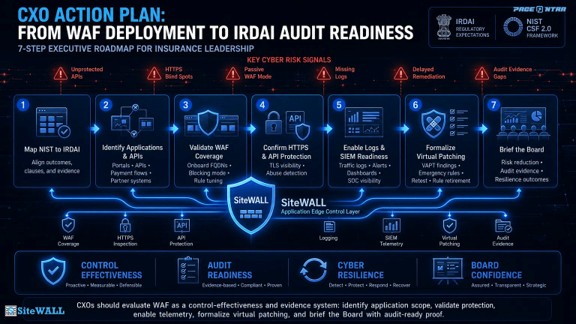
Figure 5. CXO action plan roadmap: a seven-step path from WAF deployment to IRDAI audit readiness, covering scope, protection, inspection, telemetry, virtual patching, and Board reporting.
First, build a combined NIST-to-IRDAI evidence map.
Start with the NIST functions and subcategories relevant to web application security, then map each to the relevant IRDAI section or clause. Do this before the audit firm arrives.
Second, identify every internet-facing application and API.
Include customer portals, agent portals, broker platforms, claims workflows, payment flows, mobile backends, document upload systems, ISNP platforms, partner APIs, and third-party hosted applications.
Third, validate WAF coverage.
Check whether all relevant applications are onboarded. Confirm HTTPS inspection, API coverage, blocking mode, rule tuning, and evidence export capability.
Fourth, confirm logging and SIEM readiness.
Ensure WAF logs are retained, exportable, and correlatable. Confirm that SOC teams can see and act on application-layer events.
Fifth, formalise virtual patching.
Define how VAPT findings become WAF rules, who approves emergency rules, how changes are tested, how long rules remain active, and how they are retired after permanent remediation.
Sixth, document RACI and SLA.
Make clear what SiteWALL owns, what the organisation owns, and what must be jointly coordinated. This is essential for supplier governance and audit defensibility.
Seventh, brief the Board in business language.
Do not present WAF as a technical checkbox. Present it as a control that reduces application-layer risk, protects policyholder-facing digital channels, supports IRDAI audit readiness, and strengthens cyber resilience.
From WAF deployment to control evidence
The shift under IRDAI 2026 is not from “no WAF” to “WAF deployed.” It is from tool ownership to control evidence. For regulated insurance entities, the real maturity question is whether web application security can be mapped to NIST outcomes, linked to IRDAI clauses, monitored through operational telemetry, and proven through audit-ready evidence.
Executive conclusion
The strongest way to read IRDAI 2026 is through a NIST CSF 2.0 lens.
IRDAI gives the regulatory mandate. NIST gives the outcome structure. Web application security is where many of those outcomes become operational. SiteWALL helps deliver and evidence those outcomes for internet-facing applications and APIs.
For insurers, intermediaries, ISNPs, web aggregators, and insurance technology providers, the question is no longer whether WAF is useful.
The real question is:
Can the organisation prove that its web applications and APIs are, protected, inspected, monitored, logged, and auditable under both NIST CSF 2.0 and IRDAI Cybersecurity Guidelines?
SiteWALL is designed for that intersection.
It helps identify protected applications, block application-layer attacks, inspect encrypted traffic, protect APIs, support vulnerability management, reduce exposure through virtual patching, retain WAF-layer logs, integrate with SOC workflows, and produce audit-ready evidence.
In the new IRDAI environment, web application security is not only a technology decision.
It is a governance decision.
It is an audit-readiness decision.
It is a resilience decision.
And for digital insurance businesses, it is a business continuity decision.
Disclaimer
This article is for informational purposes and does not constitute legal, regulatory, or audit advice. Organisations should validate compliance interpretations against the official IRDAI guideline text, the Annexure III audit checklist, and their appointed auditor.