
Overview
Starting March 2026, SSL/TLS certificate validity will drop from 398 days to 47 days by 2029, per the CA/Browser Forum. Enforced by Chrome, Firefox, and Safari, this shift aims to:
- Enhance Security: Minimize risks from compromised certificates and prepare for quantum threats.
- Increase Compliance Pressure: Frequent renewals challenge GDPR, PCI DSS, and uptime.
- Demand Automation: Manual management is unsustainable with 8 renewals yearly.
Urgent Action: Audit your certificate inventory by July 2025 and automate renewals by March 2026.
SSL Certificate Validity: What’s Changing?
Current Max Validity: 398 days (~13 months) for public SSL/TLS certificates (Domain Validation, Organization Validation, Extended Validation).
In Effect Since: September 2020, driven by Apple’s policy.
Purpose: Ensures regular domain revalidation and cryptographic agility.
Validity Timeline
Effective Date | Max Validity | DCV Reuse Period |
Mar 15, 2026 | 200 days | 200 days |
Mar 15, 2027 | 100 days | 100 days |
Mar 15, 2029 | 47 days | 10 days |
Domain Control Validation (DCV): Verifies domain ownership via DNS, email, or HTTP files. By 2029, a 10-day DCV reuse period requires frequent revalidation, making automation essential.
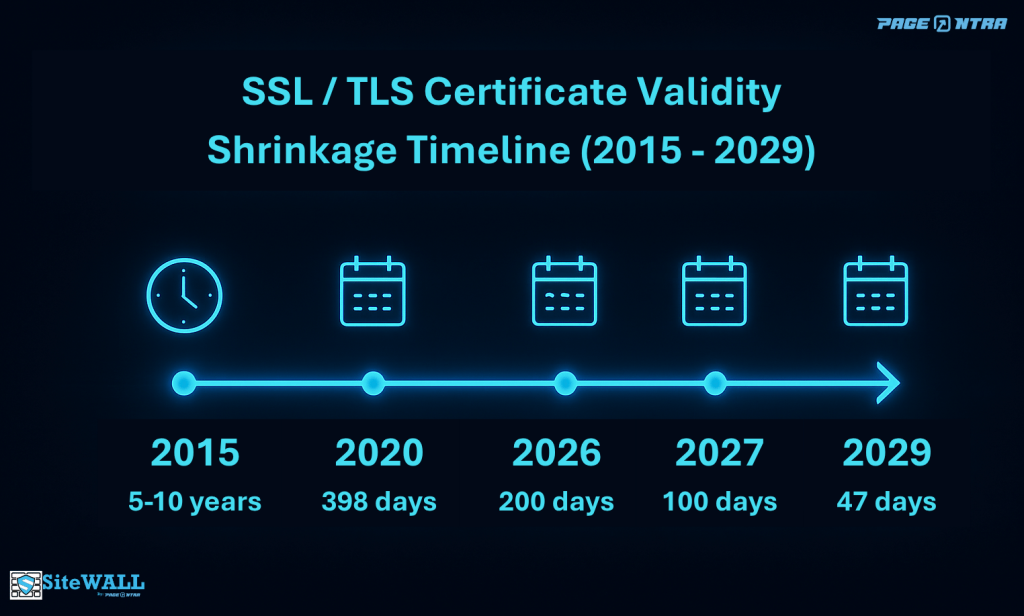
Figure 1: SSL/TLS certificate validity reduction from 5–10 years in 2015 to 47 days by 2029.
Why This Change?
- Shorter Exposure Windows: Limits damage from compromised or mis issued certificates, reducing phishing risks.
- Post-Quantum Readiness: Enables rapid adoption of post-quantum cryptography (PQC).
- Revocation Inefficiencies: Short-lived certificates reduce reliance on CRLs/OCSP, often bypassed by browsers.
- Push for Automation: 8 renewals per year by 2029 makes manual processes unscalable.
What Prompted the Shift?
- Historical Reductions: Validity dropped from 5–10 years (2015) to 398 days (2020) due to Heartbleed and SHA-1 vulnerabilities.
- Major Incidents: Let’s Encrypt revoked 3M+ certificates in 2020 due to a validation bug, exposing risks of long-lived certificates.
- Industry Pressure: Google’s 2023 90-day proposal and Apple’s 2024 45-day suggestion led to the 47-day compromise (April 2025).
Technical Deep Dive: PQC counters quantum computers that could break RSA encryption. Short validity bypasses CRL/OCSP inefficiencies, as browsers prioritize usability over revocation checks. ACME-based automation (e.g., Let’s Encrypt) is critical for scalability.
Compliance Implications
- Regulatory Risk: Expired certificates violate GDPR, HIPAA, or PCI DSS, risking fines (e.g., €20M under GDPR).
- Audit Pressure: Frequent renewals require updated audit logs for traceability.
- Vendor Oversight: Ensure third-party vendors align with shorter validity to prevent supply chain risks.
Business Impact: Real-World Wake-Up Calls
- Microsoft 2013 Outage: An expired certificate disrupted Microsoft Azure services, affecting global users and highlighting the need for proactive monitoring.
Reference: Microsoft Blog, https://azure.microsoft.com/en-us/blog/post-mortem-on-the-recent-windows-azure-storage-disruption/
- Cisco 2023 Outage: In May 2023, Cisco’s Viptela and Meraki SD-WAN products faced outages due to expired certificates from a 2017 acquisition, disrupting 200+ customers’ cloud services. [Reference: SDxCentral]
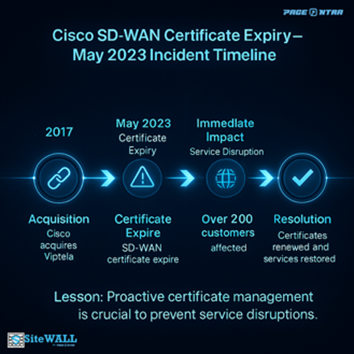
Figure 2: Cisco’s outage timeline from acquisition in 2017 to certificate expiry in 2023.
Reference – https://www.sdxcentral.com/news/cisco-sd-wan-outage-concerns-users-impacts-businesses/
Impact by Business Size
- Small Businesses:
- Challenge: Limited IT resources risk downtime and SEO penalties.
- Solution: Let’s Encrypt is free, but automation is critical.
- Medium Enterprises:
- Challenge: Manual renewals across multiple domains are error-prone.
- Solution: Centralize tracking and automate renewals.
- Large Enterprises:
- Challenge: Thousands of certificates require robust Certificate Lifecycle Management (CLM).
- Solution: Integrate scalable automation into workflows.
Renewal Frequency Snapshot
By 2029, certificates will require renewal every 6 weeks.
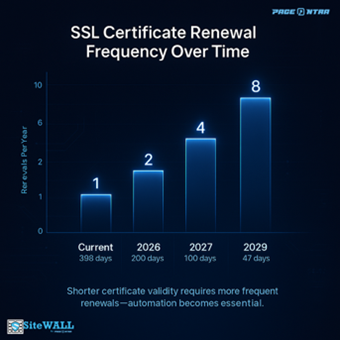
Figure 3: SSL certificate renewal frequency will rise to 8 times per year by 2029.
Cost vs. Risk: Executive View
Manual Management: $100–$200 per renewal (1–2 hours at $50–$100/hr). For 10 certificates × 8 renewals/year = $8,000–$16,000/year.
Automated Tools:
- Let’s Encrypt: Free, ideal for SMBs.
- Commercial CLM (e.g., Sectigo): $500–$2,000/year, scalable for enterprises.
Conclusion: Automation saves thousands, protects uptime, and avoids penalties.
Recommendations & Best Practices
- Automate Everything:
- Use ACME-based tools like Let’s Encrypt, Certbot, or commercial CLM platforms (Sectigo, DigiCert).
- Automate issuance, renewal, and deployment to eliminate errors.
- Hypothetical Example: A medium-sized e-commerce retailer automated 10 domains with Let’s Encrypt + Certbot in one week, eliminating certificate-related downtime and saving 15 hours monthly. “Automation transformed our operations,” says their IT Manager.
- Centralize Certificate Management:
- Adopt tools like GlobalSign’s Atlas Discovery for visibility and tracking.
- Set Expiry Alerts:
- Monitor expirations 30–60 days in advance with SSL Labs or custom dashboards.
- Protect Private Keys:
- Store in Hardware Security Modules (HSMs).
- Set Certificate Authority Authorization (CAA) DNS records.
- Train and Transition:
- Equip IT teams to manage automation tools and rapid renewal cycles.
Transition Checklist (Before Dec 2025)
- Audit all certificates and expiration dates
- Identify manual renewal gaps
- Select automation tools (e.g., Let’s Encrypt, Sectigo)
- Pilot 90-day certificates now
- Train IT staff
- Set up alerts and monitoring
- Ensure vendor compliance
FAQs
Q1: Will certificate costs increase?
No, most CAs offer multi-year plans with free re-issuance.
Q2: What happens if I miss the deadline?
Browsers may mark your site as “Not Secure,” damaging trust.
Q3: Can internal PKI use long-term certificates?
Yes, but shorter lifespans enhance internal security.
Q4: Is Let’s Encrypt enough?
Yes for SMBs; larger orgs need commercial CLM for scale.
Certificate Tool Comparison
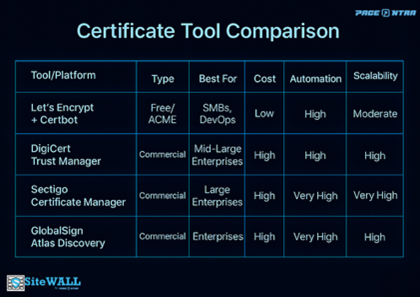
Figure 4: Tool comparison based on cost, automation, scalability, and ease of use.
Tool/Platform | Type | Best For | Cost | Automation | Scalability | Ease of Use |
Let’s Encrypt + Certbot | Free/ACME | SMBs, DevOps | Free | High | Moderate | Moderate (CLI) |
DigiCert Trust Manager | Commercial | Mid–Large Enterprises | $500–$2K/yr | High | High | High |
Sectigo Certificate Manager | Commercial | Large Enterprises | $500–$2K/yr | High | Very High | High |
GlobalSign Atlas Discovery | Commercial | Enterprises | $1K–$5K/yr | High | Very High | High |
- Let’s Encrypt: Free, ideal for SMBs but less scalable for enterprises.
- DigiCert: User-friendly with robust reporting for SMEs.
- Sectigo: Enterprise-grade with compliance focus.
- GlobalSign: Excels in discovery for complex environments.
Final Thought
The 47-day SSL/TLS validity rule is a security and compliance imperative. By embracing automation today, organizations ensure uptime, compliance, and resilience against future threats like quantum computing.
Need Help with Certificate Automation?
At SiteWALL, we protect your applications and prepare you for what is next. Avoid outages like Cisco’s 2023 incident with:
- Free SSL/TLS Certificates
- Automated Renewal & Deployment
- Certificate Monitoring with SiteWALL WAF for Web Applications.
Start today at www.sitewall.net and be ready before March 2026.
References
- CA/Browser Forum Ballot SC-081v3
- Keyfactor: 2023’s Biggest Certificate Outages (Cisco SD-WAN)
- Let’s Encrypt: CAA Bug and Mass Revocation (March 2020)
- The SSL Store: 47-Day SSL Certificate Validity by 2029