
From Protection to Trust: Understanding SSL Certificates for Complete Web Security
In the current digital age, ensuring the security of online communications is vital for businesses, individuals, and institutions alike. One of the foundational components for safeguarding web data is the Secure Sockets Layer (SSL) Certificate. As a web application firewall company, understanding SSL certificates and how they work in tandem with firewalls provides a layered security approach to keep your digital assets secure.
To truly grasp the importance of SSL certificates, imagine trying to have a confidential conversation in a crowded room without encryption. SSL certificates are like the secure channel that allows you to speak privately without anyone overhearing. With cyber threats evolving every day, SSL certificates offer a vital shield for both large and small organizations.
However, SSL alone is not enough to protect against all threats. Vulnerabilities in web applications—such as SQL injection and cross-site scripting (XSS)—still exist, which is why a combination of SSL and Web Application Firewalls (WAFs) is crucial for comprehensive protection.
What is an SSL Certificate and Why It Matters for Website and Web Application Security?
An SSL Certificate is a digital certificate that authenticates a website’s identity and enables encrypted communication between a web server and a browser. SSL certificates ensure that any data transferred remains private, protecting sensitive information such as personal data, payment details, and login credentials from malicious interception.
SSL Certificates work by encrypting data using algorithms like Rivest-Shamir-Adleman (RSA) and Elliptic Curve Cryptography (ECC). They create a secure channel over which information can be safely shared, forming the basis of modern web security protocols.
Think of SSL certificates as digital passports for your website. Just as a passport verifies your identity when you cross borders, an SSL certificate verifies a website’s identity when users visit it, assuring them they are accessing the legitimate site.
However, SSL alone does not protect against attacks that target the website or application itself. This is where a Web Application Firewall (WAF) like SiteWALL comes in, providing a layer of defense against application-level threats.
The Importance of SSL Certificates
- Data Encryption: SSL Certificates encrypt data transferred between users and websites, ensuring sensitive information like credit card details and passwords are protected.
- Authentication: SSL Certificates authenticate the identity of a website, ensuring users are communicating with the legitimate owner and not a fraudulent entity, helping mitigate phishing attacks.
- Trust and Credibility: Websites secured by SSL display visual trust indicators, such as a padlock symbol and an HTTPS prefix. These symbols signal trustworthiness, enhancing users’ confidence.
- SEO Benefits: Search engines like Google prioritize HTTPS-secured sites, improving the visibility and ranking of websites using SSL.
- Regulatory Compliance: SSL certificates are often required for regulatory compliance, such as PCI DSS for payment processing or GDPR for data protection in the EU.
- Protection Against Phishing: SSL Certificates help prevent attackers from creating fake websites, protecting users from phishing scams and potential data breaches.
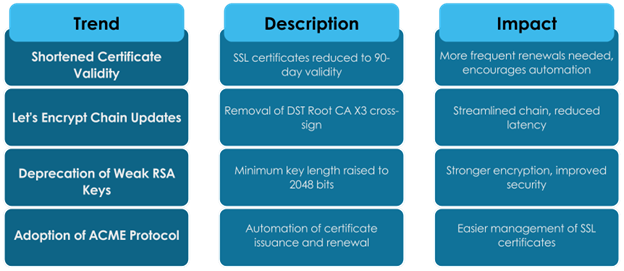
Recent Changes and Trends in SSL Certificates
- Shortened Certificate Validity Periods: SSL/TLS certificate lifespans are being shortened to enhance security. Google Chrome has announced plans to reduce the lifespan of SSL/TLS certificates from 398 days to just 90 days by the end of 2024. This shorter validity period increases security by ensuring certificates are revalidated more frequently, reducing the risk of compromised or outdated credentials being misused.
- Let’s Encrypt Chain Updates: Let’s Encrypt, a widely used Certificate Authority (CA), is making significant changes to its certificate issuance process in 2024. It will remove the DST Root CA X3 cross-sign and switch to a single ECDSA intermediate for end-entity certificates, which will make SSL certificates more efficient and improve page load times.
- Deprecation of Weak RSA Certificates: Microsoft is deprecating TLS server authentication certificates using RSA key lengths of 1024 bits by the end of 2024. The new standard will require a minimum key length of 2048 bits, emphasizing the importance of strong encryption to mitigate risks from advances in computing power.
- Automation and ACME Protocol: With the move to shorter certificate validity periods, automated certificate management has become more important. The Automated Certificate Management Environment (ACME) protocol automates certificate issuance, validation, installation, and renewal processes, making it an essential tool for organizations to efficiently manage certificates in a dynamic security landscape.
Types of SSL Certificates
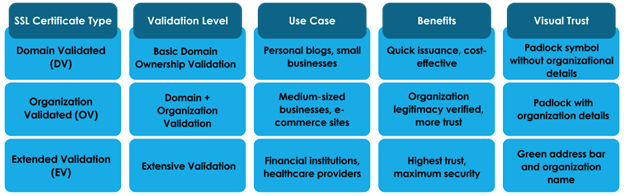
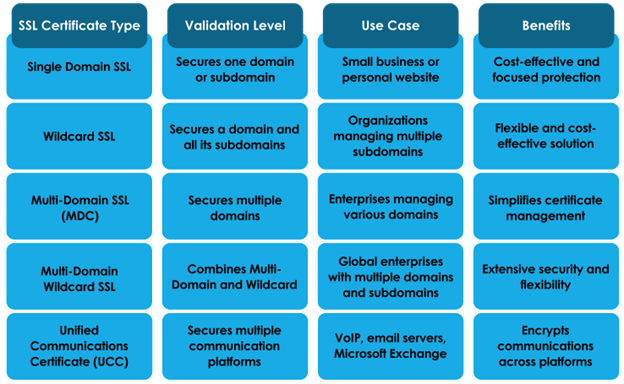
SSL Certificates can be categorized based on validation levels and scope of protection. Below, we explore each type and provide insights on when to choose them.
By Validation Level
By Scope of Protection
Common Misconceptions about SSL Certificates
While SSL certificates are a critical component of web security, they are often misunderstood, leading to several common misconceptions:
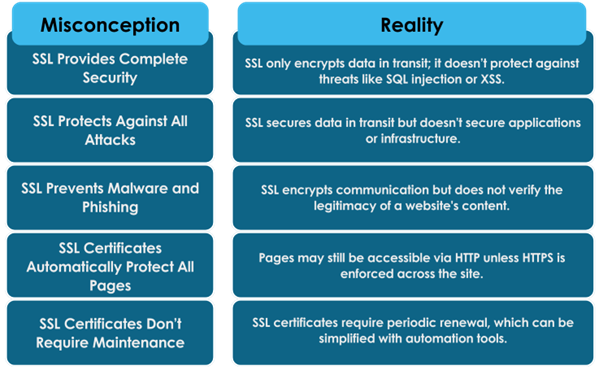
Real-World Examples
While SSL certificates provide a crucial layer of security for web applications, several high-profile incidents have demonstrated that SSL alone is not enough. Let’s look at a few real-world examples that underscore the importance of combining SSL with other security measures like Web Application Firewalls (WAFs).
- Heartbleed Bug (2014): This vulnerability in OpenSSL allowed attackers to steal sensitive information such as private keys and user credentials from servers believed to be secure. Even though these servers used SSL, the Heartbleed Bug highlighted the need for regular security audits, patching, and additional protection layers like WAFs.
- Equifax Data Breach (2017): One of the largest data breaches in history, exposing the personal information of 147 million people. A key factor was the failure to patch a known vulnerability in Apache Struts, which allowed attackers to bypass SSL and gain access to sensitive data. This incident illustrates the importance of timely updates and how WAF can prevent such attacks by detecting and blocking malicious traffic aimed at vulnerable applications.
- DigiNotar Hack (2011): The DigiNotar Certificate Authority (CA) was compromised, allowing attackers to issue fraudulent SSL certificates. These fake certificates were used to impersonate legitimate websites, leading to man-in-the-middle attacks. This incident emphasizes the importance of choosing reputable Certificate Authorities and implementing safeguards like certificate pinning and regular SSL certificate monitoring—services.
Threats to SSL Certificates and Safeguarding Measures
Threats to SSL Certificates:
- Man-in-the-Middle (MITM) Attacks
- Certificate Spoofing
- Expired Certificates
- Private Key Compromise
- Certificate Authority (CA) Compromise
- Phishing and Social Engineering
- Weak or Deprecated Encryption
Safeguarding SSL Certificates:
- Timely Renewal: Implement automated reminders or renewal processes.
- Use Strong Encryption: Opt for 2048-bit RSA or ECC.
- Protect Private Keys: Use encryption and restrict access to authorized personnel.
- Implement Certificate Monitoring: Monitor and ensure certificates are up to date.
- Use Reputable CAs: Always select trusted and reliable Certificate Authorities.
- Multi-Factor Authentication (MFA): Secure access to SSL certificate management.
- Automated Certificate Management (ACME Protocol): Automate certificate management to reduce risks.
- Revocation and Replacement: Immediately revoke compromised certificates.
Benefits for Web Application Firewalls
SSL certificates, in tandem with Web Application Firewalls (WAFs), provide comprehensive security for web applications:
- Enhanced Security: SSL encryption ensures data cannot be intercepted during transit, while WAFs filter malicious traffic.
- Trust: Combining a trusted SSL certificate with a robust WAF like SiteWALL reassures users that their data is safe.
- Optimized Performance: SSL offloading with a WAF reduces the server load for encryption processes, optimizing performance.
Comparison Table: SSL Certificates Alone vs SSL with WAF
Security Aspect | SSL Certificates Alone | SSL Certificates + WAF |
Encryption | Yes (Data-in-transit) | Yes (Data-in-transit). WAF can inspect encrypted traffic for malicious content when configured with SSL decryption. |
Protection from MITM Attacks | Yes, but vulnerable if expired | No direct impact on MITM attacks; WAFs protect against application-layer attacks. |
Private Key Protection | Yes, but dependent on manual processes | No direct impact: private key protection requires separate processes (e.g., HSMs) |
Vulnerability Management | Limited to encryption | WAFs offer broader protection (application-level) via virtual patching. |
This comparison helps highlight the importance of integrating additional security layers beyond SSL certificates.
Executive Call to Action
Securing your web applications and APIs is critical to safeguarding your business in today’s digital economy. SiteWALL Web Application Firewall (WAF) provides advanced AI-driven protection against evolving threats. Take the next step in securing your digital assets with a free web assessment and a 30-day free license for SiteWALL WAF to protect your web applications and APIs.
Checklist for SSL Certificate Implementation
- Determine the level of validation required (DV, OV, EV).
- Identify the scope of protection needed (Single Domain, Wildcard, Multi-Domain).
- Choose a reputable Certificate Authority (CA).
- Implement automated certificate management to handle renewals.
- Test SSL installation and check for vulnerabilities using SSL tools.
- Ensure all sensitive web pages are covered by HTTPS.
- Monitor certificates and ensure timely renewal.
- Store private keys securely using HSMs or strong encryption.
Conclusion
Think of an SSL Certificate as your digital bouncer, keeping malicious actors out and ensuring that only trusted users can securely interact with your web applications. SSL certificates are not just about encrypting data—they are about establishing trust, ensuring compliance, and maintaining a secure and professional online presence.
As the digital landscape continues to evolve, it’s important to stay ahead of the curve by embracing emerging trends such as post-quantum cryptography (PQC) and blockchain-based certificate management. PQC will become increasingly important as quantum computers threaten to break current encryption algorithms. Blockchain technology can enhance the security and transparency of certificate management systems.
To further enhance your understanding and implementation of SSL certificates, consider exploring the following resources:
- SSL Labs’ SSL Server Test: A free online service that performs a deep analysis of the configuration of any SSL web server on the public Internet.
- Certificate Transparency Logs: Publicly auditable records of issued SSL certificates, which make it harder for CAs to issue fraudulent certificates.
- Let’s Encrypt: A free, automated, and open certificate authority.
Secure your digital presence today by deploying the right SSL certificate and ensuring your business is protected from evolving cyber threats. Combine it with a robust Web Application Firewall like SiteWALL to achieve end-to-end security and build user confidence. Contact us now to learn more about how SiteWALL can further secure your web applications.
Additional Resources:
- NIST Post-Quantum Cryptography Standardization
- Open Quantum Safe
- SSL Server Test
- Certificate Transparency
- Let’s Encrypt
Frequently Asked Questions (FAQs)
- Why is SSL important for SEO?
SSL is crucial for SEO because search engines like Google prioritize HTTPS-secured websites, resulting in better rankings and increased visibility.
- How often should SSL certificates be renewed?
SSL certificates now have a maximum validity period of 90 days. Automated renewal processes, like using the ACME Protocol, can ensure continuous protection without manual intervention.
- What are the key differences between SSL and TLS?
SSL (Secure Sockets Layer) and TLS (Transport Layer Security) are both encryption protocols, but TLS is the successor to SSL, offering stronger encryption and better security features.
- How does an SSL certificate work with a Web Application Firewall (WAF)?
An SSL certificate encrypts data in transit, while a WAF like SiteWALL provides protection against application-level threats, ensuring a layered security approach.