

From Threats to Protection: Secure Web Applications for Business Continuity.
Introduction: The Executive Imperative for Cybersecurity
In today’s digital-first economy, secure online platforms are essential for corporate growth and stability. As businesses increasingly rely on web applications to connect with customers and deliver services, they become attractive targets for cybercriminals using advanced attacks like Cross-Site Scripting (XSS), SQL Injection (SQLi), and Remote Code Execution (RCE). For executives, cybersecurity has shifted from being merely an IT issue to a vital business responsibility that impacts revenue, reputation, and overall operational integrity.
Now more than ever, C-suite leaders recognize that effective cybersecurity is crucial for protecting their organization’s assets, brand image, and financial health. Addressing these risks is not just a technical necessity; it’s a strategic imperative that plays a significant role in ensuring long-term success.
- Cross-Site Scripting (XSS): Protecting User Trust
What is XSS?
Cross-Site Scripting (XSS) allows attackers to inject malicious scripts into trusted websites, compromising user data and hijacking sessions. For businesses that depend on customer engagement through web portals, this poses a direct threat to user trust
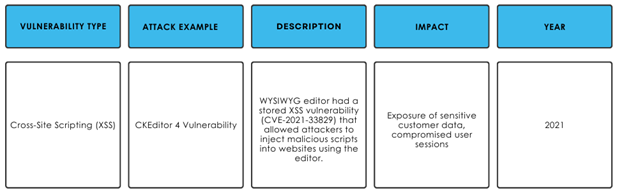
Real-World Exploit: CKEditor 4 Vulnerability (2021)
In 2021, a stored XSS vulnerability (CVE-2021-33829) was discovered in CKEditor 4, a widely used WYSIWYG editor. This vulnerability allowed attackers to inject malicious scripts into websites using the editor, impacting numerous websites, including those built with popular CMS platforms like Drupal.
Executive Takeaway:
XSS vulnerabilities can erode customer trust and lead to significant compliance challenges. Executives must ensure that security teams implement proactive defenses, such as input validation, content security policies (CSP), and output encoding, to prevent these attacks.
Mitigation Steps:
- Implement strict input validation to sanitize user inputs.
- Enforce Content Security Policy (CSP) headers to block the execution of unauthorized scripts.
- Ensure that all user-generated content is properly encoded before rendering in browsers.
- SQL Injection (SQLi): Guarding Your Most Valuable Data
What is SQL Injection?
SQL Injection occurs when attackers inject malicious SQL code into a web application’s database queries, gaining unauthorized access to sensitive information. For organizations handling large volumes of personal or financial data, SQLi can lead to catastrophic breaches.
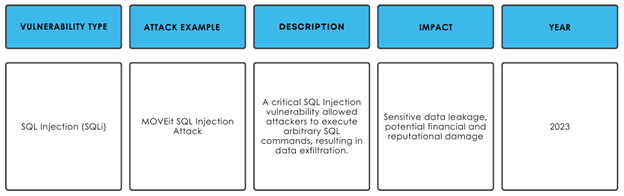
Real-World Exploit: MOVEit SQL Injection Attack (2023)
In 2023, Progress Software’s MOVEit Transfer product was compromised due to a critical SQL Injection vulnerability. This allowed attackers to exfiltrate sensitive data from numerous organizations, leading to significant data breaches.
Executive Takeaway:
SQL Injection attacks target one of your most critical assets—your data. Executives must ensure that security teams implement strong database protections, such as parameterized queries and least-privilege access, to prevent attacks.
Mitigation Steps:
- Use prepared statements and parameterized queries to prevent malicious SQL commands.
- Apply least-privilege access to databases to limit what each user or application can access.
- Regularly audit and monitor database queries for signs of unusual activity.
- Cross-Site Request Forgery (CSRF): Defending Business Integrity
What is CSRF?
Cross-Site Request Forgery (CSRF) occurs when attackers trick authenticated users into performing unwanted actions, such as making unauthorized transactions or changing critical settings.
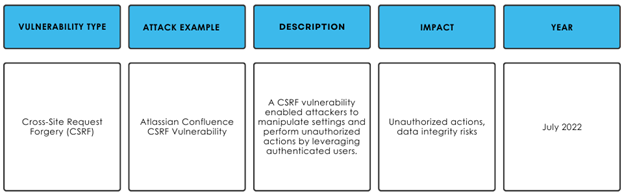
Real-World Exploit: Atlassian Confluence CSRF Vulnerability (2022)
In July 2022, Atlassian Confluence was found to have a critical CSRF vulnerability that allowed attackers to force authenticated users to execute unwanted actions, such as changing settings and compromising data.
Executive Takeaway:
For executives, defending against CSRF attacks means ensuring robust validation processes are in place. Implementing anti-CSRF tokens and same-site cookie policies is critical to maintaining the integrity of digital transactions and user actions.
Mitigation Steps:
- Use anti-CSRF tokens to ensure that every action is validated and authorized.
- Enforce SameSite cookie policies to restrict cookie sharing across different websites.
- Ensure multi-factor authentication (MFA) is in place for sensitive actions.
- Remote Code Execution (RCE): Controlling the Threat Landscape
What is RCE?
Remote Code Execution (RCE) allows attackers to execute arbitrary code on your servers, leading to full system compromise. This can enable data theft, ransomware attacks, and even complete system takeovers.
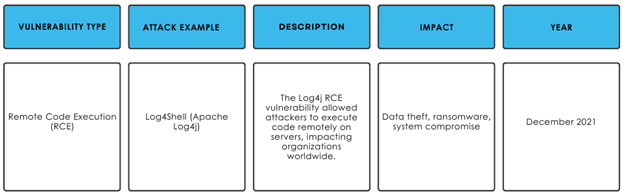
Real-World Exploit: Log4Shell (Apache Log4j) (2021)
In December 2021, the Log4Shell vulnerability in Apache Log4j allowed attackers to exploit millions of systems globally, leading to widespread data breaches and ransomware attacks.
Executive Takeaway:
RCE vulnerabilities can cripple an organization by giving attackers full access to your infrastructure. C-suite leaders must ensure timely patching and the deployment of Web Application Firewalls (WAFs) to monitor and block suspicious traffic.
Mitigation Steps:
- Ensure timely patching of all software and applications.
- Deploy Web Application Firewalls (WAFs) to block malicious traffic attempting to exploit RCE vulnerabilities.
- Conduct regular security audits to identify potential RCE risks.
- API Vulnerabilities: Securing the New Frontier
What are API Vulnerabilities?
As APIs become critical to connecting services and applications, they also become an attractive target for attackers. API vulnerabilities often involve improper input validation, broken authentication, and data leakage.
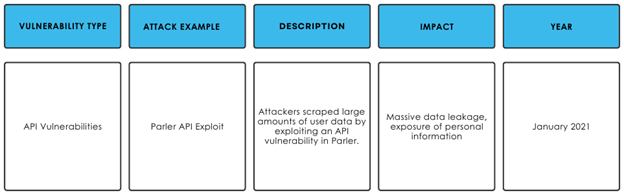
Real-World Exploit: Parler API Exploit (2021)
In January 2021, Parler’s API was exploited, allowing attackers to scrape vast amounts of user data, including personal details and geolocation, leading to massive data leaks.
Executive Takeaway:
API vulnerabilities are a growing concern as businesses integrate more services. Leaders must ensure strong authentication and input validation to secure APIs and prevent unauthorized access to sensitive data.
Mitigation Steps:
- Implement strong authentication and authorization measures for APIs.
- Ensure input validation is in place to prevent malicious payloads from passing through APIs.
- Regularly test and audit API endpoints for security vulnerabilities.
Recent Real-World Examples of Web Application Exploits
- Spoutible API Exploit (January 2024): In January 2024, Spoutible experienced a significant data breach due to an API vulnerability. The vulnerability exposed sensitive user information, including email addresses, hashed passwords, and other personal details. This breach affected around 207,000 users and highlighted the critical importance of securing API endpoints to prevent unauthorized data access.
- Trello Account Leak (January 2024): In January 2024, Trello faced a data leak where a hacker exploited an unsecured API to associate 15 million email addresses with public Trello profile data. The compromised information included usernames, email addresses, and full names. The attacker put this data up for sale on the dark web, increasing the risk of phishing and other targeted attacks. Atlassian, Trello’s parent company, responded by improving the API security to prevent further unauthorized access.
- Peloton API Vulnerability (2021): In 2021, a vulnerability in Peloton’s API allowed unauthorized access to user account data, including personally identifiable information (PII) and workout history. This vulnerability resulted from improper authentication mechanisms that enabled anyone to access user data without logging in. Peloton subsequently addressed the issue by enhancing its API security.
- Omni Hotels Attack (January 2024): In January 2024, Omni Hotels faced an attack that leveraged zero-day vulnerabilities in Ivanti software. This resulted in the theft of credentials and potential exposure of sensitive data, impacting customer privacy. The incident emphasizes the importance of applying timely patches to software and staying vigilant regarding zero-day threats.
- Web DDoS Attacks (2023-2024): Between 2023 and 2024, Layer 7 DDoS attacks targeted web applications, with peak traffic reaching up to 201 million requests per second. These attacks posed severe threats to industries such as finance and education. To counter these attacks, it is crucial to deploy Web Application Firewalls (WAFs) and other mitigation techniques to detect and block such high-volume malicious traffic.
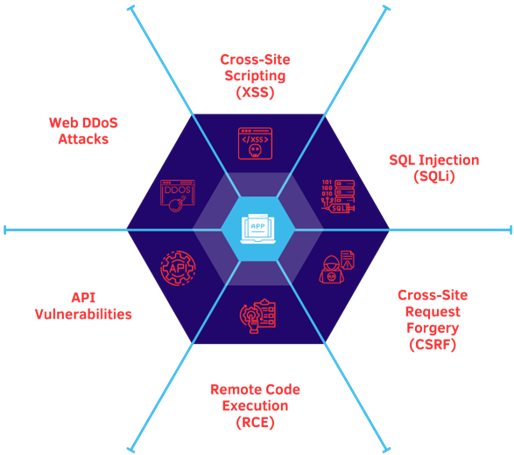
- XSS: WAFs detect and block suspicious scripts injected into web forms or URL parameters, preventing XSS attacks before they reach the user’s browser.
- SQL Injection: By inspecting incoming queries for malicious SQL code, WAFs can block SQL Injection attempts, safeguarding the organization’s databases from unauthorized access, data leakage, or manipulation.
- CSRF: WAFs detect unusual request patterns and verify the legitimacy of requests. By doing this, they help prevent unauthorized actions that could compromise user accounts or lead to fraudulent transactions.
- RCE (Remote Code Execution): WAFs monitor for patterns indicative of RCE attempts, blocking malicious payloads that aim to execute arbitrary code on servers.
- Directory Traversal: WAFs block attempts to manipulate file paths that could expose sensitive directories and files, ensuring that unauthorized access to internal server files is prevented.
- API Vulnerabilities: As APIs become increasingly critical, WAFs monitor API traffic for anomalies, enforce rate-limiting, and validate API requests, helping to prevent API abuse, data theft, and unauthorized access.
SiteWALL: Securing a Wide Spectrum of Industries
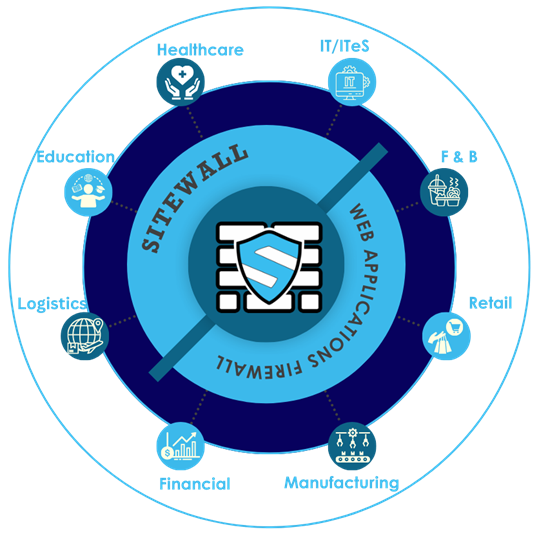
For leadership teams, investing in WAF technology offers peace of mind knowing that their web applications are shielded against a variety of sophisticated attack vectors.
Executive Call to Action
As C-suite leaders, securing your web applications and APIs is critical to safeguarding your business in today’s digital economy. SiteWALL Web Application Firewall (WAF) provides advanced, AI-driven protection against evolving threats. Take the next step in securing your digital assets with
- Get Your Free Web Application Security Assessment today.
- Claim Your 30-Day Free Trial of SiteWALL WAF and experience the power of intelligent, real-time protection for your web applications and APIs.”
Take Action: Protect Your Digital Assets with SiteWALL
In today’s rapidly evolving digital landscape, cyber threats can cripple businesses overnight. Don’t wait for a breach to disrupt your operations—proactively safeguard your web applications and APIs with SiteWALL Web Application Firewall (WAF).
- Get Your Free Web Application Security Assessment today. Identify potential vulnerabilities before attackers do.
- Claim Your 30-Day Free Trial of Experience real-time protection with SiteWALL’s advanced, AI-driven defense mechanisms.
With SiteWALL WAF, you’ll benefit from:
- Comprehensive protection against XSS, SQL Injection, RCE, and CSRF attacks.
- Real-time threat detection and mitigation.
- AI-powered defenses that adapt to new and evolving threats.
Don’t wait until it’s too late. Act now to secure your business and protect your reputation.
Get started today: www.sitewall.net/register
Contact us for a free consultation: contact@pagentra.com