

Executive Summary
To fortify cybersecurity across India’s securities market, the Securities and Exchange Board of India (SEBI) introduced the Cybersecurity and Cyber Resilience Framework (CSCRF). This framework adopts a risk-based approach, adjusting cybersecurity measures according to the size and risk level of each organization. Key elements include mandatory Security Operations Centers (SOCs) for real-time monitoring, the Cyber Capability Index (CCI) for ongoing evaluation and strategies for addressing emerging threats like quantum computing. The CSCRF aligns with global standards, ensuring compliance and enhancing security resilience.
This blog aims to help C-suite executives understand the CSCRF and offers practical advice on safeguarding their companies against growing cyber threats.
Strategic Importance of Compliance
Adhering to SEBI’s CSCRF is more than a regulatory requirement—it’s a strategic move that strengthens the resilience of regulated entities. By following the CSCRF’s guidelines, organizations can better anticipate, withstand, and recover from increasingly complex and frequent cyberattacks. Compliance with the CSCRF not only fulfills regulatory obligations but also positions organizations as leaders in cybersecurity, ensuring they are prepared for future challenges.
The framework’s design is rooted in global best practices, making it adaptable to the evolving threat landscape. By aligning with international standards, SEBI aims to create a robust defense against sophisticated cyber threats, particularly in the context of increasing interconnectivity and digitalization in the financial sector.
Primary Benefits for Regulated Entities (REs) Using the CSCRF
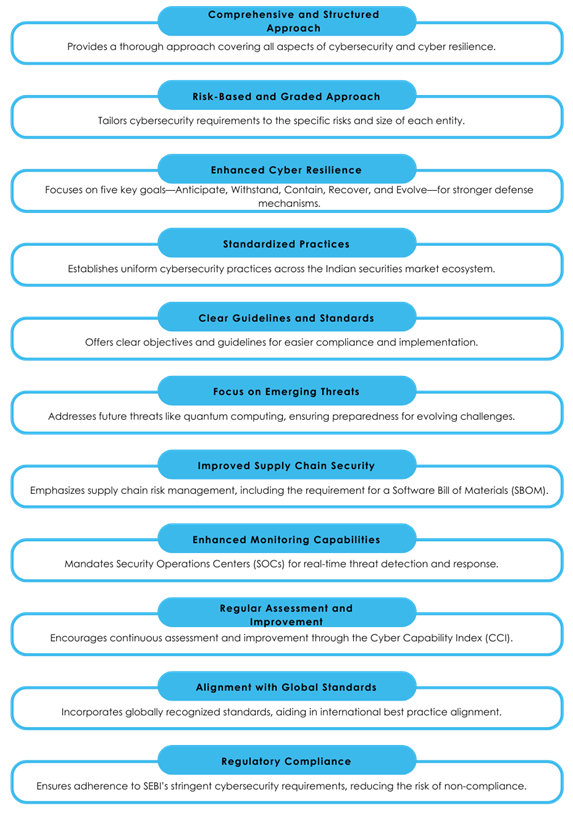
Implementing the CSCRF reveals significant advantages, providing a foundation for understanding its broader implications.
- Introduction to the CSCRF
The SEBI Cybersecurity and Cyber Resilience Framework (CSCRF) is a robust regulatory framework designed to improve cybersecurity practices across SEBI-regulated entities, including Credit Rating Agencies (CRAs), Mutual Funds (MFs), Market Infrastructure Institutions (MIIs), and Alternative Investment Funds (AIFs). The framework establishes a standardized approach to managing and reducing cyber risks, ensuring entities are prepared to handle the increasing complexity and volume of cyberattacks.
Evolution and Context
The CSCRF is part of SEBI’s broader efforts to address the increasing cyber threats facing the Indian financial sector. The evolution of this framework reflects the growing sophistication of cyberattacks and the need for a proactive, resilient approach to cybersecurity. Over time, SEBI has enhanced this framework to address new challenges, including those posed by emerging technologies like quantum computing.
- Purpose and Scope
The primary goal of the CSCRF is to safeguard the Indian securities market by enforcing stringent cybersecurity and resilience measures. It applies to a wide range of organizations, ensuring all follow a consistent cybersecurity protocol, regardless of size or function. The framework’s graded approach allows for customized requirements based on each entity’s specific risks, categorized by operational scale and criticality.
Core Principles
The CSCRF is built on several core principles, including governance, risk management, protection of critical infrastructure, incident response, and continuous monitoring. These principles are designed to create a resilient cybersecurity environment that can adapt to evolving threats and protect the integrity of the Indian financial system.
- Framework Structure
The CSCRF is divided into four main sections, each focusing on different aspects of resilience and cybersecurity:
- Part I: Objectives and Standards (Page 53)
The goals of each security control are outlined in this part, along with the requirements that REs must meet in order to abide by the framework. It acts as the cornerstone around which the remainder of the framework is constructed.
- Part II: Guidelines (Page 79)
Part II offers comprehensive suggestions on how REs can carry out the requirements and meet the goals mentioned in Part I. REs are advised to implement the best practices and mandatory rules in this section to fortify their cybersecurity defenses.
- Part III: Compliance Formats (Page 133)
Standardized forms for reporting CSCRF compliance are provided in this area for REs. It guarantees reporting uniformity and facilitates SEBI’s evaluation of compliance amongst all firms.
- Part IV: Annexures and References (Page 152)
The annexures offer extra resources that are necessary for putting the framework into practice and ensuring compliance, like audit procedures, scenario-based testing techniques, and the Cyber Capability Index (CCI).
Together, these elements create a comprehensive and organized framework that supports effective cybersecurity practices.
- Regulated Entities and Categorization
The CSCRF applies to a broad spectrum of SEBI-regulated entities, classified based on their operational scale, clientele, and sensitivity.

By categorizing entities based on their specific risks, the CSCRF ensures all entities implement necessary safeguards while considering their unique operating contexts.
Tailored Requirements
The CSCRF’s graded approach ensures that cybersecurity requirements are proportionate to the risks and operational scale of each entity. This flexibility allows smaller entities to comply without the burden of unnecessary measures, while larger entities implement more comprehensive protections.
- Key Features of the CSCRF
5.1 Graded Approach
The CSCRF’s graded approach categorizes entities into five groups based on their size, clientele, transaction volume, and other relevant factors. This approach ensures flexibility and scalability, allowing the framework to adapt to different entity sizes and risk profiles.
5.2 Cyber Capability Index (CCI)
The Cyber Capability Index (CCI) is a tool introduced by the CSCRF to measure how well organizations are prepared for cyber threats. It helps identify weaknesses and track improvements over time.
- MIIs must undergo third-party assessments of their CCI twice a year.
- Qualified REs must conduct self-assessments of their CCI annually.
The CCI provides a systematic way for organizations to compare their cybersecurity measures to industry standards and make regular enhancements
5.3 Mandatory Security Measures
To build a strong cybersecurity framework, the CSCRF outlines specific security steps that every organization must follow. These measures include governance, risk management, technical controls, and incident preparedness and recovery.
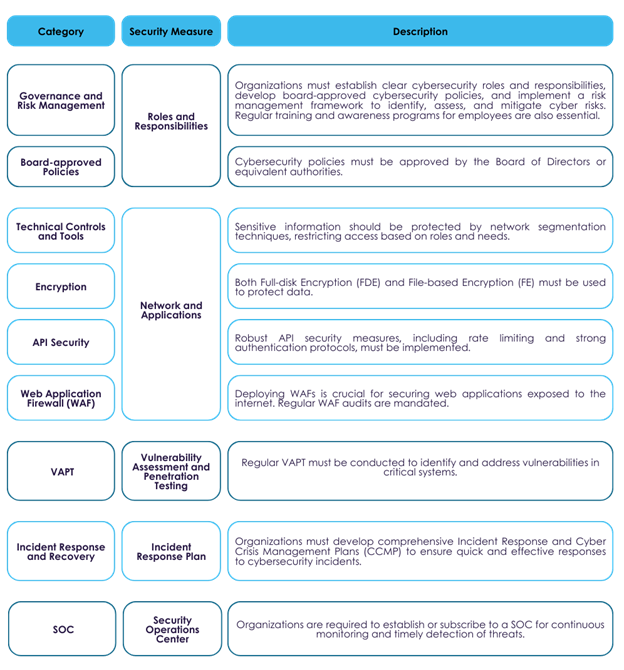
5.4 Applicability and Periodicity of Standards
This section outlines the specific applicability and periodicity of the standards mentioned in the CSCRF, providing a clear understanding of how often and to whom these standards apply.
Sr. No. | Standard/Guideline and Clause | Applicability | Periodicity |
1. | Cyber resilience third-party assessment using CCI (GV.OV.S4) | MIIs | Half-yearly |
Cyber resilience self-assessment using CCI (GV.OV.S4) | Qualified REs | Annually | |
2. | Submission of CCI self-assessment evidence (GV.OV.S4) | MIIs and Qualified REs | Within 15 days of CCI assessment completion |
3. | REs Cybersecurity and cyber resilience policy review (GV.PO.S2) | All REs | Annually |
4. | REs Cybersecurity risk management policy (GV.PO.S4) | All REs | Annually |
5. | IT Committee for REs meeting periodicity (Guidelines for GV.PO – Guideline 9) | All REs except small-size and self-certification REs | Quarterly |
6. | REs’ risk assessment (threat-based) (ID.RA.S2) | MIIs | Half-yearly |
Qualified, Mid-size REs | Annually | ||
7. | User access rights, delegated access, and unused tokens review (PR.AA.S5) | MIIs and Qualified REs | Quarterly |
Other REs | Half-yearly | ||
8. | Review of privileged users’ activities (PR.AA.S11) | MIIs and Qualified REs | Quarterly |
Other REs | Half-yearly | ||
9. | Cybersecurity training program (PR.AT.S1) | All REs | Annually |
10. | Review of RE’s systems managed by third-party service providers (GV.SC.S4) | MIIs and Qualified REs | Half-yearly |
Other REs | Annually | ||
11. | Functional Efficacy of SOC (DE.CM.S1 – Guideline 4) | MIIs and Qualified REs | Half-yearly |
Other REs using third-party SOC or Market SOC services | Annually | ||
12. | Red Teaming exercise (DE.DP.S4) | MIIs and Qualified REs | Half-yearly |
13. | Threat hunting (DE.DP.S5) | MIIs and Qualified REs | Quarterly |
14. | Cybersecurity scenario-based drill exercise (RC.RP.S3) | MIIs and Qualified REs | Half-yearly |
Other REs | Annually | ||
15. | Review and update of contingency plan, continuity of operations plan (RS.MA.S3) | MIIs and Qualified REs | Half-yearly |
Mid-size and small-size REs | Annually | ||
16. | Evaluation of cyber resilience posture (EV.ST.S5) | Mid-size and Small-size REs | Annually |
5.5 Future Proofing
The CSCRF considers potential future threats, such as quantum computing, that could challenge current security systems. The framework prepares organizations to address both current and emerging cyber threats.
- Quantum-Safe Encryption: Ensures encryption strategies can withstand potential quantum computing threats.
- AI-Driven Threat Detection: Leverage AI and machine learning to enhance real-time threat detection and response.
- Compliance and Deadlines
The CSCRF sets clear deadlines for compliance:
- January 1, 2025: Entities already covered by existing SEBI cybersecurity rules must comply by this date.
- April 1, 2025: New entities must comply by this date.
Entities need to implement necessary measures and report their compliance using standardized forms provided in the framework.
- Reporting and Audits
Regular cybersecurity audits, conducted by CERT-In empaneled auditors, are required. These audits cover critical systems, network security devices (including WAFs), and SOC operations. MIIs and Qualified REs must assess their Cyber Capability Index (CCI) regularly and report results to SEBI. Scenario-based testing is mandatory to evaluate the effectiveness of incident response plans.
- Roles and Responsibilities
To ensure effective implementation, the CSCRF assigns clear roles and responsibilities to different stakeholders:
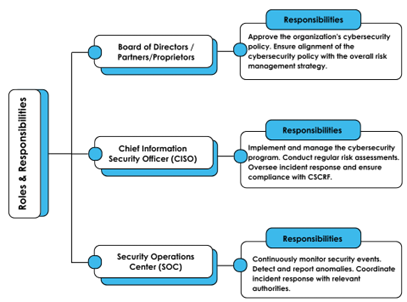
- Implementation Challenges and Recommendations
9.1 Challenges
- Complexity: The comprehensive nature of the CSCRF may pose implementation challenges for smaller REs with limited resources and cybersecurity expertise.
- Cost of Compliance: Implementing a SOC, conducting regular VAPT, and acquiring advanced encryption technologies may be financially demanding.
9.2 Recommendations
- Phased Implementation: Start with critical security measures and gradually expand cybersecurity capabilities.
- Leveraging Third-Party Services: Outsource cybersecurity functions like SOC operations or VAPT to reduce costs.
- Continuous Training and Awareness: Regularly train employees to understand their roles in cybersecurity and stay updated on the latest threats.
Quick Tips for Compliance
- Prioritize identifying critical cyber risks early
- Implement a phased approach if resources are limited.
- Regularly update incident response plans and SOC capabilities.
Impact of Non-Compliance
Non-compliance with the CSCRF can lead to serious consequences:
- Regulatory Scrutiny: SEBI may initiate investigations and enforce actions for non-compliance.
- Penalties and Fines: Non-compliance can result in fines or other penalties.
- Reputation Damage: Non-compliance can damage an entity’s reputation, leading to loss of client confidence.
- Increased Cybersecurity Risks: Non-compliant entities are more vulnerable to cyber threats.
It is crucial for all regulated entities to comply with the CSCRF to avoid these risks and contribute to a more secure financial ecosystem.
Conclusion
As cyber threats grow more sophisticated, the SEBI Cybersecurity and Cyber Resilience Framework (CSCRF) is essential for protecting India’s securities market. By implementing this framework, entities can enhance their security, ensure compliance, and strengthen the financial ecosystem. Continuous improvement and proactive adaptation are key to staying ahead of evolving cyber risks.
Call to Action
Don’t wait until it’s too late! The deadline for CSCRF compliance is fast approaching. Ensuring your organization is fully compliant is not just a regulatory requirement; it’s a strategic necessity to protect your digital assets and secure your future in the financial sector.
Take Immediate Action:
- Assess Your Cybersecurity Posture: Evaluate your current cybersecurity measures against CSCRF standards. Identify gaps and prioritize critical areas for improvement.
- Implement Key Security Measures: Develop and execute a comprehensive implementation plan, including establishing a Security Operations Center (SOC), conducting regular Vulnerability Assessment and Penetration Testing (VAPT), and deploying robust tools like a Web Application Firewall (WAF) with API security.
- Invest in Training and Awareness: Regularly train your team on the latest cyber threats and the importance of adhering to CSCRF guidelines.
- Leverage Third-Party Expertise: Collaborate with CERT-In empaneled cybersecurity experts to ensure full compliance and resilience against evolving threats.
- Get a Free Web Assessment: SiteWALL offers a complimentary Web Assessment of your web applications. Identify vulnerabilities and secure your systems before the compliance deadline.
Contact SEBI for Guidance: For any clarifications or specific compliance requirements, reach out to SEBI directly.
Remember: Compliance is not just about meeting regulations—it’s about safeguarding your organization’s future. Start your CSCRF implementation journey today with SiteWALL and fortify your position in a safer, more resilient financial sector.
Reference
SEBI Cybersecurity and Cyber Resilience Framework (CSCRF) 2024