

In the ever-evolving landscape of cyber threats, modern enterprises need a multi-layered approach to protect their digital assets. Web Application Firewalls (WAF) and Next-Generation Firewalls (NGFW) are two critical components in this strategy. While they both serve the purpose of security, they have distinct roles and capabilities. This blog will delve into their differences, strengths, and the importance of deploying both for comprehensive protection.
Introduction
As cyber threats become more sophisticated, enterprises must adopt a multi-faceted security strategy. A layered defense approach is essential to protect against a wide array of threats targeting different layers of the IT infrastructure. Two key components of this strategy are Web Application Firewalls (WAF) and Next-Generation Firewalls (NGFW). Understanding their unique roles and how they complement each other is crucial for robust cybersecurity.
Understanding The Role of Web Application Firewalls (WAF)
A WAF is a specialized security solution designed to safeguard web applications and APIs from a wide range of cyberattacks. By filtering and monitoring HTTP/HTTPS traffic, WAFs identify and block malicious activities aimed at exploiting vulnerabilities in applications.
Key Features of WAFs:
- Targeted Protection: WAFs excel at defending web applications from common threats like SQL injection, cross-site scripting (XSS), and other application-layer attacks.
- Deployment Flexibility: They can be deployed as cloud services, hardware appliances, or virtual appliances, offering flexibility to match your infrastructure.
- Behavioral Analysis: Advanced WAFs leverage behavioral algorithms to distinguish between legitimate and malicious traffic patterns.
- Comprehensive Security: Modern WAFs are evolving into Web Application and API Protection (WAAP) solutions, providing broader protection, including:
- Malware scanning:Detects and blocks malware in web traffic.
- Integrated application and API vulnerability scanning:Identifies and helps remediate security weaknesses.
- Bot management:Mitigates automated attacks and malicious bot activity.
- Application DDoS protection:Defends against distributed denial-of-service attacks targeting applications.
- Defacement detection:Alerts to unauthorized changes in web content.
- Integrated threat intelligence:Provides up-to-date information on emerging threats and attack patterns.
The Role of Next-Generation Firewalls (NGFW)
Next-Generation Firewalls (NGFW) enhance the capabilities of traditional firewalls by incorporating advanced security features. NGFWs are designed to protect networks from unauthorized access while providing deeper inspection of network traffic.
Key Features of NGFWs:
- Advanced Threat Prevention: NGFWs include built-in features such as antivirus, anti-malware, and intrusion prevention systems (IPS) to detect and block sophisticated threats.
- Network Segmentation: By creating secure zones within the network, NGFWs control and monitor communications, preventing unauthorized access to sensitive areas.
- Application Awareness: NGFWs offer granular control over network traffic by identifying and managing applications, allowing for more precise security policies.
- Comprehensive Filtering: NGFWs provide URL filtering and content inspection, enabling organizations to enforce security policies and protect against web-based threats.
The Synergy Between WAF and NGFW – Why You Need Both
While WAFs and NGFWs serve different purposes, they complement each other to provide comprehensive security coverage. Here’s why deploying both is essential:
Layered Security:
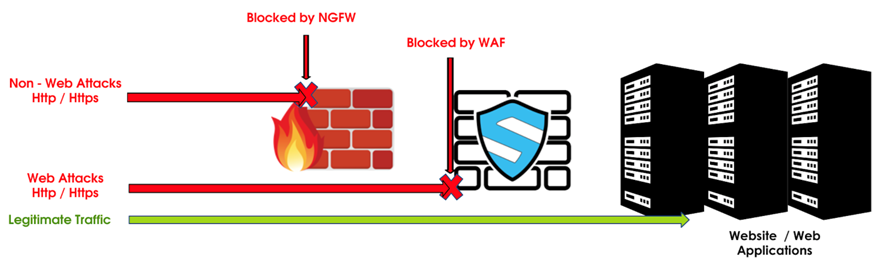
- Application Layer Protection: WAFs safeguard web applications at the application layer (Layer 7), preventing attacks that exploit application vulnerabilities.
- Network Layer Protection: NGFWs secure the network layers (Layers 3 and 4), protecting against network-based attacks and unauthorized access.
Comprehensive Threat Mitigation:
- API Security: WAFs excel in protecting APIs, a critical component of modern web applications, from malicious exploitation.
- Bot Management: WAFs provide advanced bot management to mitigate automated attacks, while NGFWs handle broader network security threats.
- Virtual Patching (WAF): WAFs can offer virtual patching, providing temporary protection for known vulnerabilities in applications until a permanent fix is deployed.
- Advanced Threat Detection: NGFWs integrate advanced threat detection and prevention capabilities, such as antivirus and IPS, to block sophisticated attacks.
Real-World Examples
Reserve Bank of India (RBI)
- Cybersecurity Framework for Banks and Financial Institutions: In 2016, the RBI released a comprehensive cybersecurity framework that explicitly recommends the use of NGFWs and WAFs. This framework outlines specific security controls and measures that banks and financial institutions must adopt to protect their critical systems and sensitive data.
- Emphasis on Layered Security: The RBI framework emphasizes the importance of a defense-in-depth approach, with multiple layers of security to mitigate various threats. This strongly implies the use of both NGFWs (for network-level protection) and WAFs (for application-layer protection).
- Specific Recommendations: While the framework doesn’t prescribe specific vendors or products, it does outline the functional requirements for NGFWs and WAFs, including intrusion prevention, deep packet inspection, application control, and vulnerability scanning.
Securities and Exchange Board of India (SEBI)
- Consolidated Cybersecurity and Cyber Resilience Framework (CSCRF): SEBI’s CSCRF, released in 2022,also emphasizes the need for NGFWs and WAFs as part of a holistic cybersecurity strategy for stock exchanges, depositories, and other regulated entities.
- Cybersecurity Audits and Assessments: SEBI regularly conducts cybersecurity audits and assessments of regulated entities. These audits often include evaluating the implementation and effectiveness of NGFWs and WAFs as critical security controls.
- Guidance and Circulars: SEBI has issued various circulars and guidance notes on cybersecurity best practices, often referencing the importance of NGFWs and WAFs in safeguarding against evolving threats.
Compliance and Industry Standards
WAFs and NGFWs play a crucial role in helping enterprises comply with various industry standards and regulatory requirements. For example, the Payment Card Industry Data Security Standard (PCI-DSS) mandates the use of firewalls to protect cardholder data.
Integration with Other Security Solutions
WAFs and NGFWs can be integrated with other security solutions such as SIEM (Security Information and Event Management) systems, endpoint protection, and identity management systems. This unified security approach ensures comprehensive monitoring and protection across the entire IT infrastructure.
Comparative Analysis: WAF vs. NGFW
Aspect | WAF | NGFW |
Primary Focus | Web application security | Network security with application awareness |
Functionality | Filters HTTP/HTTPS traffic | Inspects and filters network traffic across multiple layers |
Deployment | Cloud, hardware, virtual | Hardware, virtual, often integrated with other network security devices |
Key Features | API security, bot management, DDoS protection | Antivirus, anti-malware, intrusion prevention, URL filtering |
Use Case Comparison
- Protecting web applications and APIs vs. protecting the network and its resources: WAF is ideal for fine-grained application control, while NGFW excels in broad network traffic filtering.
- Protecting against targeted attacks vs. network threats: WAF targets app-specific attacks, whereas NGFWs guard against network-based threats.
- API protection vs. network-wide intrusion prevention: WAF offers specialized features like API security and bot management, while NGFWs provide comprehensive intrusion prevention and URL filtering.
Feature Comparison: WAF vs. NGFW
The following table provides a detailed comparison of the features offered by WAF and NGFW solutions:

Conclusion
In the face of evolving cyber threats, a robust cybersecurity strategy is essential. For CIOs, CISOs, and CEOs, understanding the complementary roles of WAFs and NGFWs is key to building a resilient defense. WAFs protect web applications and APIs, while NGFWs safeguard the broader network. Together, they create a defense-in-depth strategy, protecting sensitive data and ensuring business continuity. Investing in both WAF and NGFW solutions demonstrates a proactive approach to cybersecurity. Equip your organization with these essential tools to stay ahead of the ever-changing threat landscape.