

DBIR 2025 Cybersecurity Insights: Key Findings from Verizon’s Data Breach Investigations Report
Introduction: A Global Wake-Up Call
Verizon’s 2025 Data Breach Investigations Report (DBIR) delivers a stark picture of the cybersecurity landscape, analyzing 22,052 incidents and 12,195 confirmed breaches across 139 countries. As threats evolve—fueled by AI, third-party risks, and human error—organizations worldwide, from India’s BFSI sector to global enterprises, must adapt swiftly to stay ahead. Let’s dive into the critical insights and actionable steps to secure your future.
Top Key Findings: What’s Driving Breaches in 2025
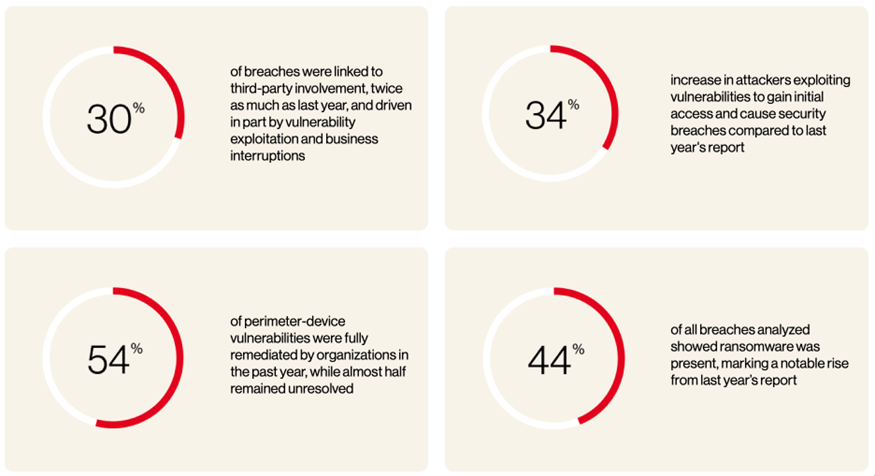
Summary of critical cybersecurity trends from Verizon’s 2025 DBIR, highlighting third-party risks, vulnerability exploitation, perimeter device weaknesses, and rising ransomware incidents.
- Third-Party Risks Double, Prolonging Exposure
Breaches involving third parties surged to 30%, doubling from 15% in 2024. The median remediation time for leaked third-party credentials stretched to 94 days—leaving organizations vulnerable for over three months. Industries like healthcare and finance, often reliant on vendors, were hit hardest, with 40% of their breaches tied to third-party failures.
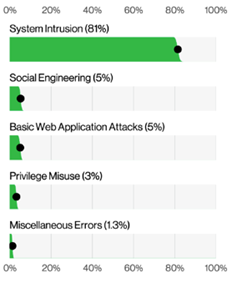
System intrusion dominates breaches involving third parties, followed by social engineering and basic web application attacks. Source: Verizon 2025 DBIR, Figure 11.
- Ransomware Soars, But Payments Decline
Ransomware spiked to 44% of breaches, a 37% year-over-year increase. Small and medium businesses (SMBs) bore the brunt, with 88% of their breaches involving ransomware, compared to 39% for larger firms. The median ransom dropped to $115,000, and 64% of victims refused payment—up from 50% in 2023—signaling a shift toward recovery over capitulation.
Real-World Example:
The 2024 MOVEit file transfer breach demonstrated this speed, affecting hundreds globally within days. U.S. Secret Service collaboration disrupted the attack within 48 hours, highlighting law enforcement’s role per the DBIR.
- Vulnerability Exploitation Hits New Highs
Vulnerability exploitation as an initial access vector jumped 34%, now accounting for 20% of breaches. Edge devices and VPNs were prime targets, with 22% of such exploits focusing on these systems—an eightfold rise from 2024’s 3%. Unpatched systems in sectors like education saw a 50% higher breach rate, according to APCERT 2024 data.
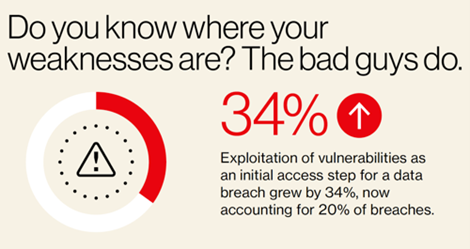
Vulnerability exploitation continues to climb sharply (Source: Verizon 2025 DBIR)
- Human Error: The Unyielding Weak Link
Human actions—errors, social engineering, or misuse—drove 60% of breaches, a persistent trend (cf. 74% in DBIR 2023). Phishing emails, increasingly AI-crafted, succeeded in 35% of attempts, underscoring the need for robust awareness programs across all employee levels.
- Espionage Breaches Surge with Mixed Motives
Espionage-motivated breaches rose to 17%, with 70% leveraging vulnerability exploitation. Interestingly, 28% of state-sponsored actors also pursued financial gain, a trend blurring traditional motives. The Asia-Pacific region, per APCERT, saw a 25% uptick in such incidents, often targeting critical infrastructure.
- AI: A Double-Edged Sword in Cybercrime
AI-generated phishing emails doubled over two years, becoming harder to detect. Additionally, 15% of employees accessed generative AI platforms on corporate devices, often using non-corporate emails (72%) or without integrated authentication (17%), risking sensitive data leaks. India’s CERT-In flagged a 20% rise in AI-related incidents in BFSI sectors in 2024.
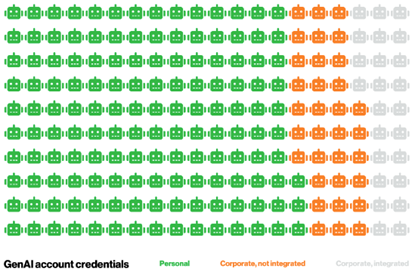
Breakdown of GenAI service access: A majority of employees used personal accounts for accessing AI platforms, highlighting major data protection risks – Source: Verizon 2025 DBIR, Figure 9.
- BYOD Risks Amplify Credential Theft
Non-managed devices with corporate credentials accounted for 46% of compromised systems. Worse, 54% of ransomware victims had domains found in credential dumps. This overlap between personal and corporate devices demands stricter controls, especially in remote work-heavy regions like South Asia.
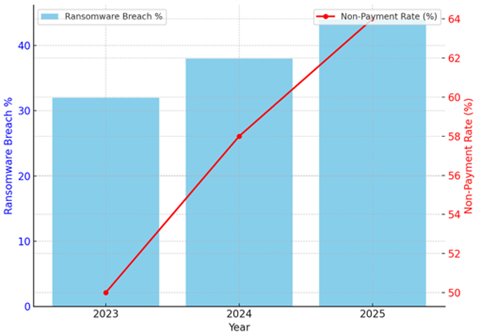
Ransomware Trends (2023–2025) – Ransomware breaches are up, but non-payment rates are climbing too — showing stronger corporate resilience against extortion. (Source: Verizon 2025 DBIR)
Strategic Recommendations: Act Now to Stay Ahead
Fortify Third-Party Defenses:
Implement a third-party risk management program with real-time monitoring. Tools like BitSight or RiskRecon can assess vendor security posture, aiming to cut remediation times below 60 days.
Patch Faster, Smarter:
Target a 14-day patching window for perimeter and edge devices. Use platforms like Tenable or Qualys to prioritize critical fixes, especially for VPNs and firewalls.
Empower Your People:
Launch quarterly phishing simulations and awareness training, targeting a 90% employee recognition rate. Use platforms like KnowBe4 to gamify learning.
Secure AI Usage:
Enforce strict policies around generative AI tools—mandate SSO authentication and block non-corporate email access. Deploy DLP solutions like Symantec to monitor data flows.
Adopt Proactive Technology:
Deploy Next-Gen WAFs (e.g., from SiteWALL) alongside real-time threat intelligence feeds. Integrate zero-trust architecture principles to minimize BYOD risks.
Quick Checklist for 2025:
- Audit third-party vendors for credential exposure
- Patch critical vulnerabilities within 14 days
- Train staff on AI phishing risks
- Deploy WAF and DLP tools
- Implement zero-trust policies for remote devices
Conclusion: Turn Threats into Triumphs
The 2025 DBIR paints a clear picture: cyber threats are more interconnected and sophisticated than ever, from third-party vulnerabilities to AI-driven attacks. Organizations must act decisively building resilient, proactive defenses that address technology, people, and partners.
Start today: audit your weakest links, patch relentlessly, and empower your team to outsmart attackers. Tomorrow’s security depends on today’s actions—secure your future now with 2025 cybersecurity trends in mind.