

PCI DSS 4.0 Compliance Deadline: Why WAF is Mandatory Under Requirement 6.4.2
Only 14 Days Left! Is Your Organization Ready?
With just 14 days until March 31, 2025, organizations handling payment card data face a critical deadline. PCI DSS 4.0 Requirement 6.4.2 mandates an automated technical solution—typically a Web Application Firewall (WAF)—to protect public-facing web applications. This marks a major shift from optional to required real-time threat mitigation.
If your organization hasn’t implemented a WAF yet, the time to act is now—before auditors enforce compliance.
Related Read: Need a full breakdown of PCI DSS 4.0 changes? Check our Comprehensive Guide to PCI DSS v4.0 Mandates & Deadlines.
Learn More: Detailed WAF Feature Guide on how SiteWALL’s WAF protects against evolving threats. Need a full breakdown of PCI DSS 4.0 changes? Check our Comprehensive Guide to PCI DSS v4.0 Mandates & Deadlines.
Reference: See the official PCI DSS v4.0 document by the PCI Security Standards Council.
Understanding the Rule Change
PCI DSS 3.2.1 Requirement 6.6
“Ensure all public-facing web applications are protected against known attacks, either by performing application vulnerability assessment at least annually and after any changes, or by installing an automated technical solution that detects and prevents web-based attacks (for example, a web-application firewall) in front of public-facing web applications, to continually check all traffic.”
Modified in PCI DSS 4.0 Requirement 6.4.2
“Deploy an automated technical solution for public-facing web applications that continually detects and prevents web-based attacks.”
Key Changes:
Before: Organizations could choose annual vulnerability assessments or a WAF.
Now: An automated solution, typically exemplified as a WAF, becomes mandatory for real-time attack detection and prevention per 6.4.2 guidance, effective March 31, 2025.”
Compliance Deadline: March 31, 2025.
The PCI Security Standards Council (PCI SSC) now mandates a continuously active solution, with WAFs spotlighted as the go-to option in official guidance. This ensures real-time protection over periodic scans.
Why This Matters: Real-World Risk
Public-facing web apps face relentless threats:
- SQL Injection – Attackers steal payment data with malicious queries.
- Cross-Site Scripting (XSS) – Exploits hijack user sessions.
- Remote Code Execution (RCE) – Grants unauthorized system control.
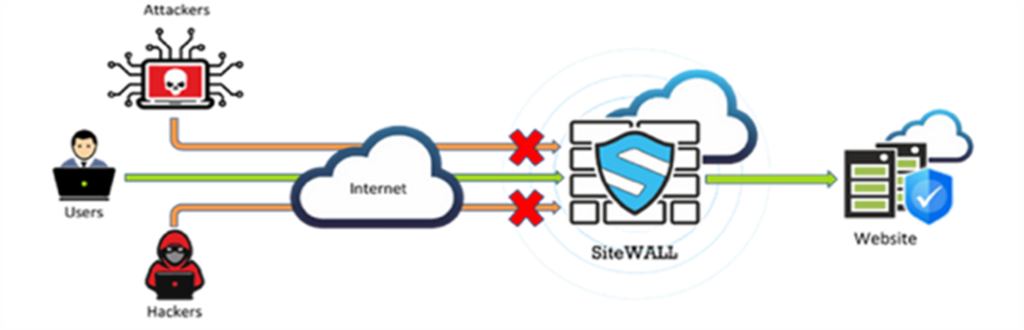
Did You Know? The 2024 Verizon Data Breach Investigations Report states that over 70% of breaches exploit web app vulnerabilities, underscoring PCI DSS 4.0’s demand for continuous, automated defense.
Non-compliance risks include:
- Failed PCI audits, triggering penalties or loss of payment privileges.
- Cyberattacks exposing customer data.
- Downtime from rushed deployments.
- Fines ranging from $5,000 to $100,000 per month, depending on payment brand policies and the severity of non-compliance
Quick Quiz: Why does 6.4.2 mandate real-time protection?
- a) Speed up apps
b) Block threats instantly ✅
c) Cut costs
Check “Why This Matters” if you’re unsure!
How SiteWALL Ensures PCI DSS 4.0 Compliance
Why WAFs Over Other Solutions? While security solutions like Runtime Application Self-Protection (RASP) and Intrusion Prevention Systems (IPS) enhance application security, Web Application Firewalls (WAFs) provide a dedicated layer of defense against web-based threats. WAFs block real-time attacks, mitigate zero-day vulnerabilities with virtual patching, and ensure continuous compliance monitoring—making them the most effective and widely recommended solution for PCI DSS 4.0 compliance.
SiteWALL’s Next-Gen WAF is built to meet PCI DSS 4.0 Requirement 6.4.2 seamlessly:
- Zero-Configuration Deployment:Protects apps instantly with minimal setup.
- AI-Powered Threat Detection:Blocks real-time attacks, reducing false positives.
- Automated Virtual Patching:Shields unpatched flaws fast.
- Advanced Logging & Compliance Reports:Generates detailed audit logs for PCI compliance.
- Bot & API Security:Stops automated threats and API abuse.
- Full Blocking Mode Implementation: 100% of SiteWALL customers rely on full-blocking mode for high-security protection from day one of implementation.
- SiteWALL delivers compliance plus cutting-edge security.
Technical Insights: Configuring a WAF for PCI DSS Compliance
Can your WAF stop a bot in seconds? A WAF isn’t just about installation—it’s about smart setup to meet 6.4.2’s demands. Here’s how:
- Rule Set Optimization: Customize and automate rules with AI/ML-based WAF for your web applications, balancing security and usability.
- Real-Time Threat Intelligence: AI uses threat feeds (e.g., OWASP patterns) to spot attacks, enabling instant blocking.
- Virtual Patching: Temporary shields for unpatched flaws, shrinking exposure windows.
- Bot & API Defense: AI/ML-based rate limiting and anomaly detection stop bots and API abuse.
- Logging & Compliance Auditing: Capture all events (e.g., “SQL injection attempt blocked; IP: 192.168.1.1; Country: US; User Agent: Mozilla/5.0; Date: 3/14/25; Time: 10:00 AM; Severity: High”) for PCI audits.
Industry Insight: Next-Gen AI-powered WAFs with advanced bot management effectively block automated threats before they reach applications
Act Now – The Deadline Looms!
Beat the Clock—Here’s How:
With 17 days left (March 14 to March 31, 2025), act fast:
- Assess:Map your web apps and defenses.
- Plan & Budget:Secure WAF resources and training.
- Deploy & Test:Roll out SiteWALL’s Next-Gen WAF and validate it.
- Monitor:Set up logs and alerts.
Poll: Deployed a WAF yet? a) Yes b) In progress c) Not yet—comment below!
Don’t Delay! Secure your apps before March 31.
Secure Your PCI DSS Compliance Today! → https://www.sitewall.net/register
FAQ: Common Questions About PCI DSS 4.0 & WAF Compliance
Q.Is a Web Application Firewall (WAF) mandatory for PCI DSS 4.0 compliance?
- Yes, Requirement 6.4.2mandates an automated solution, typically a WAF, to detect and prevent web-based attacks.
- What happens if I don’t implement a WAF by March 31, 2025?
A. Non-compliance can result in fines from $5,000 to $100,000 per monthand loss of payment processing privileges. - How does a WAF help with PCI DSS compliance?
A. A WAF blocks threats in real-time, applies virtual patching, and provides audit logs for compliance reporting. - What’s the best WAF for PCI DSS 4.0 compliance?
A. SiteWALL’s AI-powered WAFdelivers zero-configuration deployment, automated threat detection, and bot security—ideal for PCI DSS compliance.
Final Thoughts
PCI DSS 4.0 Requirement 6.4.2 isn’t just a rule—it’s a shield. A WAF like SiteWALL ensures compliance, prevents breaches, protects customers, and future-proofs your security. Act now—visit our PCI DSS v4.0 Compliance Guide for more, or contact us today!